Can small brands win in AI Search? Visibility strategies beyond big budgets
AI Search you don’t need a massive budget and hundreds of links to be visible. Here's a comprehensive playbook for small brands to win in AI Search results.

When your competitors are major brands with massive budgets and you’re running a small business, it can feel like the game is rigged from the start. But AI search brings something entirely different – a chance for small brands to compete on a level playing field, provided they know where to look and how to position themselves.
What is AI Search and why is it a game-changer for small brands?
AI search refers to results that appear inside AI chats and tools like ChatGPT, Perplexity, Claude, or Gemini. When a user asks, “What’s the best project management tool for startups?”, they no longer see a list of ten blue links. Instead, they receive a direct answer that draws on only a handful of trusted sources.
This is a fundamental shift from traditional SEO.
The story looks like this:
Traditional SEO: You aimed to rank #1 among ten results – competing with potentially thousands of pages.
AI Search: You aim to be cited in the AI’s response as one of 2–5 trusted sources. That’s the new #1.
Why does this change the game for small brands? Because in AI Search you don’t need a massive budget and hundreds of links to be visible. You need well-structured content, clear authority in your niche, and citations in trusted publications.
Small brands in AI Search – can they gain visibility and how to achieve it?
Can a small brand appear in AI-generated answers? More and more users are seeking information through AI instead of traditional search engines – ChatGPT alone now has over 800 million weekly active users, generating billions of queries that never show up in Google Analytics. For small businesses and SEO specialists, this shift brings both new challenges and unique opportunities.
Below, we explain how AI Search works, where it pulls its knowledge from, why traditional SEO isn’t enough anymore, and which strategies can help small brands boost their visibility in AI-generated answers – without astronomical budgets.

AI Search vs. traditional search – a new battle for attention
AI-based search is radically different from traditional Google results. Instead of a list of links, users often receive a single, synthesized answer from a chatbot – an answer built on the basis of information from a source trusted by a Large Language Model (LLM). That’s great for users, but it also means your website may never appear as a clickable source. What’s more, AI systems rank information in a completely different way than Google ranks pages.
In traditional SEO, your goal is to achieve the highest possible position in the SERP. In AI Search, what matters is whether your brand is mentioned or cited in the answer at all. It’s not enough to “be somewhere on the list” – if the AI skips over your brand, the user will never hear about it.
The gap between visibility in Google and visibility in AI tools
Research shows that the gap between visibility in Google and visibility in AI-powered platforms can be massive: some brands that dominate in Google are completely invisible in ChatGPT or Perplexity.
A 2025 study analyzing 18,377 semantically matched queries found a low overlap of results: Perplexity had 43% domain overlap and only 24% URL overlap with Google, ChatGPT had 21% domain overlap and 7% URL overlap, and Gemini had 28% domain overlap and 6% URL overlap. This means that even the best-matching AI model covers less than one-quarter of Google’s top URLs, creating a large visibility gap for brands optimized for traditional SEO. Other analyses, such as the Ahrefs Brand Gap Analysis, emphasize that:
Brands ranking #1 on Google can be completely omitted from AI responses due to differences in data sourcing and citation.
Where does the gap come from?
AI models learn from enormous datasets – web pages, articles, forums – and often rely on their own internal methods for retrieving information. Tools like ChatGPT or Claude generate answers based on their training data (e.g. sites like Wikipedia or Reddit), as well as occasionally on live browsing or connected plugins. Platforms such as Perplexity go one step further – they perform real-time searches and cite specific sources within their responses.
As a result, the “ranking” within AI Search depends on whether your information is considered worth citing – either by the model itself (if it already “knows” it) or by its supplementary search mechanism.
In practice, a single accurate mention of your brand in an AI-generated response can be far more valuable than being the tenth link in a traditional SERP. Users perceive it as a trusted recommendation from an intelligent assistant, not just another random search result.
Below, we’ll explore how small brands can increase their chances of being noticed and cited by AI systems.
Why traditional SEO doesn’t translate directly to AI Search
Not long ago we focused on E-E-A-T (Experience, Expertise, Authoritativeness, Trustworthiness) and high Google rankings, assuming that was the key to success. In the world of AI Search these factors, while still important, don’t guarantee your appearance in AI answers.
Here are the main reasons why classic SEO isn’t enough:
AI “thinks” differently than Google’s algorithm
Chatbots don’t rely directly on PageRank or backlinks. Instead, they compose answers by synthesizing information from multiple sources. They may skip over SEO-overoptimized content in favor of content that answers the question more directly or comes from a recognized source – even if that source isn’t #1 on Google. The result: you can have excellent SEO and a top-10 SERP ranking, yet still be omitted by AI because its “knowledge base” points to a more substantive answer elsewhere.
AI’s information sources are different
ChatGPT was trained on content from Wikipedia, Reddit, forums, and articles, so it can draw on resources that don’t rank highly on Google but are valued in its training data. Google Gemini (Search Generative Experience) and Bing Chat, on the other hand, rely on their own indexes and knowledge graphs. They can generate answers from pages a user wouldn’t normally reach on page one. For example, ChatGPT often leans heavily on Wikipedia and Reddit, while Google SGE blends information from a variety of sites (sometimes niche blogs, sometimes forums), not always those with the strongest SEO.
No clicks = no feedback signals
In traditional SEO, a high position drives clicks and then user engagement (time on page, bounce rate, etc.), which indirectly affects rankings. In AI Search, users can get an answer without clicking anything (so-called zero-click). Your site might be cited by the AI or mentioned by name, but the user may never open the source, trusting the summary. That’s why classic SEO metrics (CTR, organic traffic) won’t tell you whether AI is using your content at all.
Constantly changing answers
Generative models may give slightly different answers each time depending on how the question (prompt) is phrased. Your visibility in AI can therefore be highly contextual and unstable – you might be mentioned for query X today and omitted for a very similar query Y tomorrow. That’s not the same as a stable ranking for a specific keyword.
Bottom line: high positions in Google don’t guarantee a high “position” in AI. You need to deliberately cultivate new signals and presence within the sources AI draws from. Below are strategies that work particularly well for small brands aiming to gain visibility in AI Search.

Create high-quality content (and demonstrate E-E-A-T)
Content quality has always been fundamental – but in the age of AI Search, it matters even more. AI models are trained to deliver factual and trustworthy answers, which means they prefer content that looks expertly written and credible. Here’s how to achieve that:
Show experience and expertise
Add an “About the Author” section to every key article, including a professional bio that highlights the author’s credentials and background. Add information about your company (for example, using schema.org/Organization and schema.org/Person markup for the author) to reinforce context and trustworthiness. The more transparent you are about who stands behind the content, the more likely AI will treat it as reliable.
Offer unique insights and perspectives
AI has an excellent memory for text – if you only rephrase what’s already online, you’re not adding any value. Even worse, models can detect so-called semantic duplicates (content that uses different words but conveys the same points). Don’t copy competitors. Instead, look for information gaps – questions that no one has answered yet, niche topics, or fresh data. For example, if everyone lists the same five solutions in your industry, write about three lesser-known but effective alternatives and back them up with a real case study.
Keep your structure clear and your answers concrete
Write content that’s easy to understand for both humans and AI. Use clear headings, concise paragraphs that answer specific questions, and an FAQ format when relevant. Tools like Perplexity and other “answer engines” favor pages that deliver direct, no-fluff information – concise explanations, definitions, and step-by-step lists. Avoid marketing jargon and vague claims; instead, give facts and explain how to do it. The more your article resembles a well-structured answer to a user’s query, the more likely AI will consider it useful.
Keep your content up to date
Even the best article loses value over time if it becomes outdated. AI systems increasingly prioritize freshness of information – Perplexity, for example, explicitly favors newer publications over older ones. Regularly refresh your core articles: update data, revise examples, and change the “last updated” date so AI can see that your content is current. For small brands, this can be a competitive edge – you can update your content faster than large corporations, keeping your information the most recent on the market.
Be present where AI gets its information
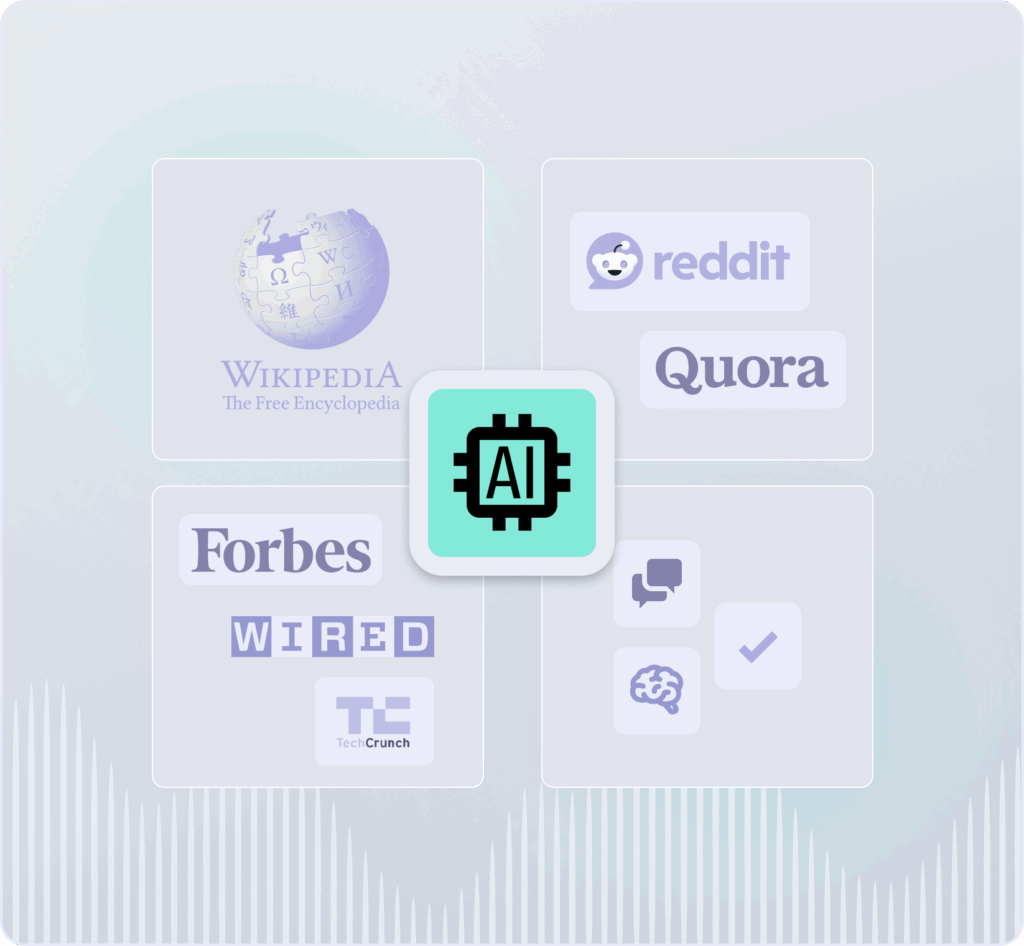
To mention your brand, AI first needs to learn about it from the sources it trusts. That’s why it’s essential to build your brand’s presence beyond your own website, in places that AI models recognize as repositories of reliable knowledge.
Wikipedia
It remains one of the primary factual sources for large language models. If your brand meets Wikipedia’s notability criteria, it’s worth striving for a dedicated page. For many small businesses, that’s challenging (you need independent publications as sources), but you can start smaller – by getting your brand mentioned as an example within relevant existing articles.
For instance, if you run a small natural cosmetics brand and Wikipedia has a page about organic skincare, adding a reference to your product (supported by a credible industry source) can help the model later associate your brand with that topic. ChatGPT and similar tools absorb this type of contextual information and often rely on Wikipedia when generating answers.
Online forums and communities (Reddit, Quora, discussion groups)
Reddit has become so valuable to Google that the company signed a licensing deal for its data – and for AI models, it’s priceless because of its authentic discussions. If people on Reddit or Quora talk about your niche, join the conversation. Contribute expert insights, help solve real problems – not as an ad, but as a way to build trust and authority.
When users organically mention your brand as a solution, that’s gold: such threads can be processed by AI and become the basis for future recommendations. Even if ChatGPT doesn’t always cite the forum by name, it can still use the knowledge.
Keep in mind that AI values authenticity – even a single genuine post praising your product by a happy customer can have an impact, as long as it gains attention and visibility. Focus on creating a product or experience that people genuinely want to talk about.
Industry media and external publications
In the eyes of AI, “authority” often equals recognized, reputable sources. Tools like Perplexity prioritize citations from outlets such as TechCrunch, Forbes, WIRED, or respected niche industry sites. While it might be difficult for a small business to land on Forbes, you can still build credibility by contributing guest articles, issuing press releases, or sharing expert commentary with industry journalists. Each mention in a respected medium increases the odds that AI will encounter your brand and use it in an answer.
Every such appearance raises your chances of being recognized when AI constructs its response. Some AI systems (like Google’s SGE) even display links to cited sources directly in the answer – so if your brand appears within those sources, users will see it right away.

Knowledge bases, Q&A sites, and expert profiles
Participate on Quora or Stack Exchange – anywhere your expertise can shine. If a certain question keeps popping up, consider posting an answer on both your own site (e.g., in an FAQ section) and on a public Q&A platform, linking between them. AI models often cite Q&A pages because their question-and-answer structure fits the conversational style of responses.
You can also strengthen your presence by building expert profiles – for instance, publishing academic or technical articles, maintaining a Google Scholar profile, or getting listed as an author on reputable platforms. When the model recognizes your name as one of an expert, it extends that credibility to your company as well.
Use structured data and technical SEO for AI
Does AI actually read your website’s code? Not directly – but technical information determines what AI can access and understand. Remember, before your content ever reaches a language model, it first needs to be indexed by a crawler (like a search engine bot or a dedicated AI bot). That’s why standard technical SEO best practices still matter – and in fact, new layers have been added.
Make sure AI can crawl your site
OpenAI has released a bot called GPTBot, which likely collects data for future versions of ChatGPT. Check your robots.txt file – if you’re blocking GPTBot or similar crawlers, you risk preventing your content from ever entering AI’s knowledge base. Allowing legitimate bots to access your site ensures your content can be discovered, parsed, and possibly referenced later.
Speed up your site and optimize UX
AI models (and their crawlers) won’t wait forever for a slow site to load. A sluggish, bloated page may be abandoned before its content is fully processed. Beyond that, think about human users: if AI cites your site and someone clicks through, they’ll expect a seamless experience. If they’re greeted by clutter, intrusive pop-ups, or slow load times, they’ll bounce instantly. A clean, fast, mobile-friendly site not only helps SEO – it builds credibility with both humans and AI systems.
Implement schema.org and structured data
Add as many relevant schema tags as possible to describe your content. For AI (and the search systems that feed it), schema markup provides crucial contextual clues. Use:
- FAQPage for your FAQ sections
- HowTo for step-by-step guides
- Product for detailed product data (including price, ratings, and attributes)
- Article with author and publication dates
- Organization for company details
While AI models don’t parse schema directly during generation, structured data helps the search engines and knowledge sources they rely on identify your content accurately – and sometimes even feature it in summaries or citations.
Keep your brand information up to date
Check how your business appears in sources like Google’s Knowledge Graph, the “About” panel, or Wikidata. You can’t control these fully, but you can influence them indirectly: update your Google Business Profile, ensure consistent NAP data (Name, Address, Phone) across directories, and correct any outdated information. When AI generates a summary about your company, it often pulls from these external databases. Make sure what it finds is accurate – your business description, years of operation, and main products should all be correct. Whenever you rebrand or change your offer, update all references so the AI doesn’t propagate outdated data.
Cite credible sources in your own content
This might not sound like a technical detail, but it is one of the most powerful trust signals for AI. When your article includes well-sourced references and outbound links to reliable publications, you increase the perceived credibility of your content. In a way, you’re creating self-verifying material – AI models treat well-cited pages as more reliable and are more likely to use or quote them. Plus, if the model pulls a snippet from your article that includes citations, it might even interpret you as a curator of authoritative knowledge.
In short: build a solid technical foundation so your content is visible, understandable, and trustworthy from a machine’s perspective. Traditional SEO – performance, crawlability, and indexing – is still the groundwork. But now, it also serves as the entry point for your brand to appear inside AI-generated results.
Create content others will cite and link to
“Link building” takes on a whole new meaning in the context of AI Search optimization. It’s no longer just about boosting PageRank but about creating content that others want to cite, because that means it’s influential in broader discussions and therefore visible to AI systems. For a small brand, a powerful strategy is to become a source others rely on. Here’s how to make that happen:
Publish original research or reports
Nothing attracts citations like fresh data. Conduct even a small-scale study in your niche – maybe a customer survey, local market analysis, or product comparison test. Then publish the results as a report or infographic. If your findings are novel, other websites will start linking to you as a data source. These citations can end up on Wikipedia, in industry articles, or presentations – and from there, it’s a short path for AI to absorb them.
Write “cornerstone” content that becomes a go-to reference
Create glossaries, checklists, or comprehensive “ultimate guides.” When someone else writes a surface-level piece, they’ll gladly link to your in-depth resource as a reference. Over time, you’ll become a cited authority. AI will pick up on that – pages that receive many backlinks tend to be treated as valuable knowledge nodes (even if the model doesn’t count PageRank per se, the training data often reflects their importance through context).
Engage in industry discussions online
If there’s an active comment section on a popular blog in your niche and you have something insightful to add, join in – and include a relevant link to your content when appropriate. The same goes for Facebook or LinkedIn groups – if someone asks a question your content answers, share the link along with a short, helpful explanation. The goal isn’t to spam links, but to add genuine value. Each mention of your brand creates another touchpoint across the web, which increases the chances of AI encountering your name or content.
Build relationships within your niche
Connect with other creators, bloggers, and micro-influencers in your field. Mention them in your own content – quote them, review their work, or reference their insights (authentically, of course). They’ll often reciprocate, creating a network of mutual citations and backlinks that boost visibility for everyone involved. For AI, this cross-referencing between multiple trusted sources is a strong signal: if several independent sites talk about something, it’s likely important.
In a nutshell, think like an editor and PR strategist. Your goal is to make sure other sources talk about your brand or content. Every mention in someone else’s article, forum, or social post is a new pathway for AI to discover you. The more of those pathways you build, the harder it becomes for artificial intelligence to ignore your brand.

Build authority and expert reputation
In the world of AI Search, brand authority is the currency that determines visibility. A small brand can compete with industry giants if it manages to project a strong image of expertise and trustworthiness. Here are several ways to strengthen those signals:
Collect positive reviews and testimonials
Customer feedback published online (Google Reviews, G2, Trustpilot, Ceneo, Opineo, etc.) shapes how your brand is perceived. When analyzing product descriptions or discussions, language models can pick up on phrases like “X has great reviews” or “users praise Y for reliability.”
While AI doesn’t aggregate star ratings, the tone of the online conversation around your brand can influence its responses. For example, when asked about the best tools in a given category, AI may mention a brand that consistently receives praise on forums. Therefore, focus on customer satisfaction, encourage honest reviews, and respond to negative feedback – don’t leave a poor impression unaddressed.
Showcase certifications, awards, and accreditations
If your company has earned any industry awards, quality certifications, or your experts hold credentials (Google, Microsoft, academic titles, professional courses), make sure to highlight them on your website and in press releases. Such information often ends up in indexed articles or brand profiles. When AI encounters sentences like “Company X, winner of award Y, specializes in…”, it strengthens your perceived authority. Mentions in connection with industry organizations or associations (e.g., memberships, partnerships) also add credibility.
Share case studies and success stories
Demonstrate real-world results. Publish project outcomes, client references (ideally including company names), and measurable achievements. This not only builds trust with potential customers but also reinforces a narrative of competence. When AI compiles information about your brand, it might include details like “Company X helped client Y increase sales by 50%” – and that could appear directly in a recommendation or AI-generated answer.
Engage an expert – or become one yourself
A small business can gain massive visibility if its representative becomes a recognized expert. Speak at conferences, host webinars, or give interviews – then feature those appearances on your website and social channels. Once your name starts showing up in expert contexts, AI will associate your brand with authority.
If you’re not ready to step into that role, collaborate with a well-known specialist (for example, as an advisor or guest contributor to a company e-book) and promote that partnership. Expert authority is contagious – when an AI model sees a respected name associated with your brand, part of that credibility transfers to you.
Monitor and respond to mentions
Track what people are saying about your brand online, especially in discussions or advice threads. If you spot misinformation about your offer, step in – clarify it on forums, correct it in your content, or publish an updated explanation. AI sometimes repeats user-generated opinions or myths; by actively managing your reputation and factual accuracy, you’re indirectly training the AI to present your business in a fair and positive light.
Maintain a consistent message across all channels
Make sure you’re communicating one unified story about who you are and what you do – on your website, social media, press appearances, and interviews. If AI encounters contradictory information (for instance, outdated descriptions or inconsistent data), it might get confused or pick the less favorable version. Consistency strengthens your brand identity within the model’s understanding and helps it recognize your business as a coherent, trustworthy entity.
Monitor your AI visibility and use the right tools
Fortunately, you don’t have to fly blind, guessing if and where AI mentions your brand. A growing set of AI Search monitoring tools can help you measure impact and find improvement opportunities. Here’s what to do:
Hands-on testing in AI
The simplest move: ask a chatbot the way your customers would and see what (and who) it mentions. Try several phrasings. For example, ask ChatGPT/Perplexity:
- “What are the best {product/service} for {audience}?”
- “Recommend a {product} for {use case}.”
You’ll see whether your brand shows up – and if not, who does. That’s valuable intel on your competitors in AI Search results. In Perplexity, you can also check the “Links” panel in the answer to see which sources were used. If you notice the AI is drawing from “Article X,” it’s worth getting visibility there (e.g., by commenting, contributing updates, or contacting the author).
Get free AI Search Visibility checklist
Dowlnoad a step by step guide on how to test your visibility in AI Search results.
“AI visibility tracker” tools
New platforms now track citations and mentions in AI much like rank trackers did for Google. We built one of these tools in our own ecosystem at Insightland specifically to keep full control over methodology, validation, and test repeatability. As a result, we measure not only basic “presence in the answer,” but also where that presence comes from and how stable it is across prompt variations.
Our system, called Brand Search Presence, lets us track any type of query:
- informational,
- commercial,
- navigational,
- long-tail,
and across all funnel stages – in the natural language formats real users employ.
The tool supports an unlimited number of keywords and multiple language markets (PL, EN, DE, ES, FR, etc.), with segmentation by country and dialect. It also allows us to test responses in parallel across several AI engines (e.g., ChatGPT, Perplexity, Gemini), controlling model version, browsing mode, and personalization settings.
Each run saves the full response text plus source links, enabling audits of why a brand was included or omitted. From there, we compute metrics such as:
- Share of Voice in AI,
- Share of Source (your domain’s share among cited links),
- brand mentions vs. competitors,
- recommendation stability across prompts,
- sentiment,
- and topic coverage (which query clusters “pick up” mentions).
Brand Search Presence also allows A/B experiments: comparing results before and after content changes, PR pushes, or technical updates to see whether a given action actually increased AI citations and recommendations.
On top of the metrics, we add manual spot checks and automatic hallucination detection so we don’t inflate KPIs with false positives.
AI search is still in its early stages. Being proactive and adaptable is a small brand’s advantage – giants often move slower. Track trends (AI-focused SEO blogs, case studies) experiment with new content formats (e.g., Custom GPTs/ChatGPT plugins, or feeding your domain data into open-source models), and think creatively.
Final words
Small brands absolutely can gain visibility in AI Search – but it requires a broader strategy than traditional SEO. The key is to think in terms of citations and presence within knowledge, not just rankings and keywords.
By creating valuable, unique content (grounded in real experience and data), ensuring your brand appears in trusted web sources, and aligning technically with how AI systems discover and interpret content, you can increase the odds that a chatbot answering your customer’s question will mention you. In a world where a single AI recommendation can be worth more than ten blue links, investing in AEO (Answer Engine Optimization) isn’t just worthwhile – it’s essential.
The good news is that many of these actions don’t require a huge budget – just savvy, consistency, and expertise, which small brands often have in their niche. Lean into your specialized knowledge (AI favors specialists over generalists), prioritize depth over volume, and build relationships and reputation. Monitor results and keep learning – do that, and you won’t just catch up to bigger competitors; you may outpace them in the race for AI’s trust.

more