GEO (Generative Engine Optimization) vs SEO – what’s really changing?
GEO (Generative Engine Optimization) - or AI Search - isn't replacing SEO. It's the next stage.


GEO takes classic SEO principles and extends them into AI-driven environments, but it still relies on the strong technical, content, and authority foundations that SEO has always built.
What is GEO really about?
Generative Engine Optimization focuses on making your brand and content visible inside AI-generated answers. We’re talking about tools like Google AI Overviews, Perplexity, ChatGPT Search, Gemini, or Copilot – not just “blue links” on SERPs. The goal here is to be cited, recommended, and summarized by language models. You want to become the source AI pulls from when it composes an answer to a user’s query.
Traditional SEO optimizes primarily for ranking positions and clicks. GEO optimizes for inclusion and prominence in the narrative that AI systems generate. The question is: does your brand get named, quoted, or used as a data source in those synthesized responses?
Source: https://blog.hubspot.com/marketing/generative-engine-optimization
Let your customers find you, wherever they look.
How does GEO change the game?
Generative engines work by analyzing multiple sources and then composing a single, coherent answer. They don’t just return a list of ranked links. When choosing which content to use, they favor pages that are clearly structured, semantically rich, up to date, and demonstrably credible. These elements go beyond keyword density or basic on-page tweaks.
This changes success metrics. GEO cares about citation frequency within linkbuilding in terms of AI, brand presence in AI answers, and the context in which your brand appears – think comparisons, rankings, expert articles. You’re looking at something different than just impressions, clicks, and average position. But the underlying signals stay the same: topical relevance, authority, user intent alignment. These remain deeply rooted in SEO best practices, which is why GEO is an evolution, not a break from the past.
Why strong SEO is still the foundation
Generative engines largely draw from the same open web index that search engines use. Pages that rank well and exhibit strong E-E-A-T still have a higher probability of being surfaced and cited by AI. At Insightland, we see GEO and SEO as a power duo: structured data, authoritative content, and high-quality sources that work for Google also feed AI assistants. Solid SEO hygiene is non-negotiable.
Backlinks illustrate this continuity. In GEO, raw link counts matter less than contextual, editorial links from trusted, topically relevant sources – but those are exactly the kinds of links advanced SEO has always prioritized. Similarly, entity-based SEO, internal linking, and semantic topic coverage – all core to modern SEO – are now central inputs helping models understand which brands belong in specific categories and answers.
GEO vs SEO – what actually differs?
| Dimension | Classic SEO focus | GEO (AI search) focus |
| Primary objective | High positions in SERPs and organic traffic growth. | Being cited, summarized, and recommended inside AI-generated answers. |
| Main success metrics | Rankings, CTR, organic sessions, on-site conversions. | Citation frequency, prominence of brand mentions, AI visibility share of voice. |
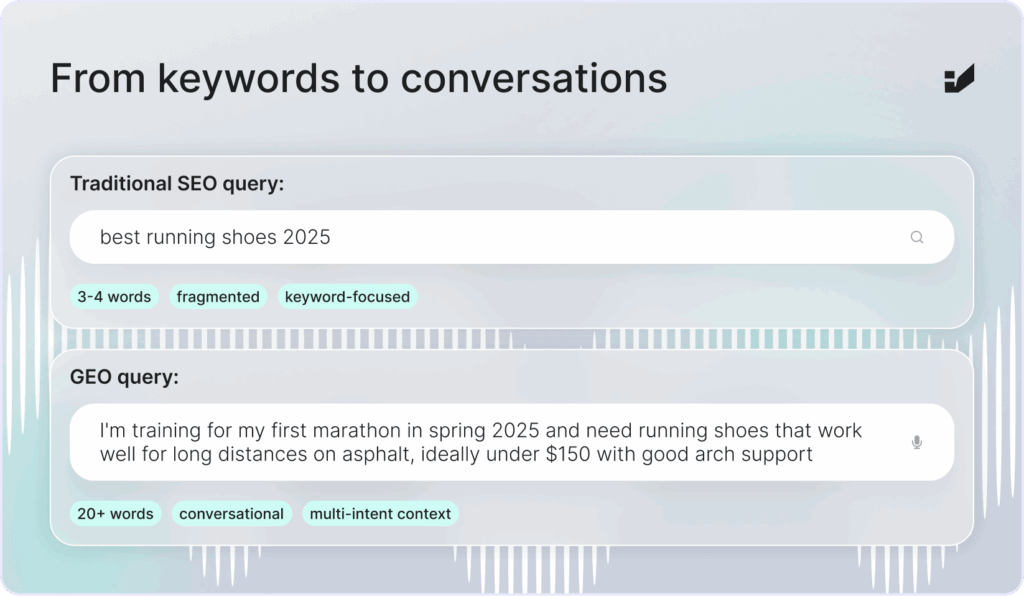
| Query patterns | Short, fragmented queries (often 3-4 words). | Longer, conversational queries (often 20+ words) with multi-intent context. |
| Key signals | Backlinks, on-page optimization, crawlability, Core Web Vitals. | Semantic completeness, entity coverage, multi-source agreement, source reputation. |
| Content design | Keyword targeting, on-page structure, internal links and metadata. | AI-friendly structure (H2/H3 questions, concise sections), rich context, clear summaries, answering clearly as first thing after heading. |
| Role of links | Authority and ranking power; PR and trust-building. | Validation of entities, reputation and co-citation patterns across trusted sources. |
| Visibility endpoint | User chooses from a list of links. | User sees a single synthesized answer with a small set of cited sources. |
GEO introduces new constraints – especially around structure, semantics, and reputation across multiple domains – but it doesn’t discard the classic SEO toolbox. It broadens where and how that toolbox gets applied.
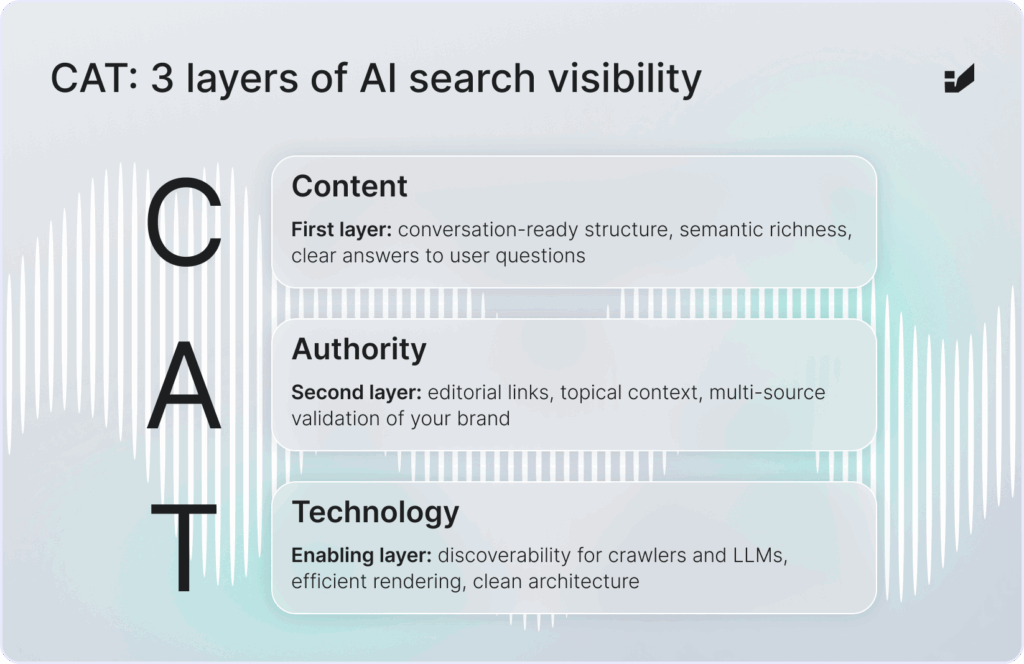
GEO and SEO meet perfectly in our CAT framework: Content and Authority remain the main levers of visibility, but they only scale if the Technology layer is clean, efficient, and easy for both search engines and LLMs to process.
CAT framework in the GEO era
The CAT framework (Content – Authority – Technology) was designed as a single playbook for visibility across Google, Bing, and AI-driven engines like ChatGPT, Perplexity, or Gemini. It aligns classic SEO with GEO requirements. The framework mirrors how LLMs work: first they “read” your content, then infer authority from patterns and mentions, and only then depend on the technical layer to access and interpret that content at scale.
Read more: https://insightland.org/blog/how-to-rank-in-chat-gpt-2025/
Content as the primary GEO signal
For GEO, content must be conversation-ready: answering full-sentence questions, covering topics semantically, and presenting information in a structure that LLMs can easily extract and summarize. This aligns with our approach to blog and landing page optimization for AI search, where headings, sections, and FAQs are crafted around real user questions to maximize the chance of being quoted inside AI-generated answers.
In practice, CAT treats content as the first and non-negotiable layer. If pages don’t clearly express expertise, context, and user value, no amount of authority or technical tuning will turn them into preferred sources for generative engines.
Authority redefined for AI and GEO
Within CAT, Authority covers both classic signals (backlinks, mentions, brand searches) and GEO-specific ones like consistent topical context and presence in trusted editorial and expert sources. LLMs infer authority not just from domain strength, but from how often a brand appears in reliable contexts, how clearly it ties to specific entities and topics, and whether multiple independent sources agree on its role in a niche.
This means link building and PR keep their importance, but shift towards high-quality, context-rich placements that strengthen semantic connections around the brand – exactly the type of authority work Insightland highlights for GEO and AI search optimization.
Read more: https://insightland.org/blog/backlinks-in-the-era-of-ai-search-do-they-still-matter-in-geo/
Get free AI Search Visibility checklist
Dowlnoad a step by step guide on how to test your visibility in AI Search results.
Technology as the hidden bottleneck
The Technology layer in CAT ensures that everything built in Content and Authority is actually discoverable and interpretable for crawlers and LLMs, especially on large and JavaScript-heavy sites. Poor rendering, inefficient crawl and render budgets, or heavily client-side content can limit or delay indexation, which in turn restricts how much of your site becomes training material or a reference pool for generative engines.
Read more: https://insightland.org/blog/how-to-rank-in-chat-gpt-2025/
A technically sound base includes, for example:
Server-side or hybrid rendering so key content is available in HTML without relying exclusively on JavaScript, reducing rendering overhead for bots and models.
Clean crawl budget management: logical architecture, minimal parameter duplication, and prioritizing key templates so search engines can efficiently cover strategic sections instead of wasting resources on noise.
Without this, even excellent content and strong authority might remain partially invisible or inconsistently used by AI systems. CAT explicitly frames Technology as the enabling layer for GEO rather than an optional extra.
Why CAT proves GEO is SEO’s evolution
CAT operationalizes the idea that GEO is built on SEO’s core: content relevance, authority signals, and technical health, extended into AI search instead of replaced. Content and Authority are the strategic drivers, but they only translate into GEO results if the Technology layer is optimized so that both traditional crawlers and LLM-focused mechanisms (like LLMs.txt, rendering strategies, log-based crawl diagnostics) can fully access and reuse your site’s information.
For data-driven teams, this means GEO isn’t a separate discipline. It’s the next iteration of SEO. Apply CAT to strengthen content, deepen authority, and remove technical friction, and the same investments will compound simultaneously in classic SERPs and in AI-generated answers.
Practical implications for data-driven teams
Content for GEO must be planned as modular, AI-readable assets: clear intros with data-backed context, H2/H3 headings formulated as user questions, short paragraphs, and bullet lists that make it easy for models to extract key information. Semantic mapping becomes mandatory: grouping related concepts, building internal topic clusters, and using structured data (FAQPage, HowTo, Review, Product, using SameAs) to help engines understand entities and relationships.
From our perspective, the most effective GEO strategies combine: data-driven intent and topic analysis, entity recognition and structuring, authority-building content, and reputation signals (expert mentions, reports, community discussions) that strengthen how models perceive the brand. For organizations already investing in robust technical SEO, analytics, and content quality, GEO isn’t a revolution that invalidates current work. It’s a high-leverage layer that turns existing SEO assets into AI search visibility, provided that structure, semantics, and trust are deliberately upgraded for generative engines.