AI Mode, AI Search, AI Overview: The Key Differences Explained
For years, search engines operated on a predictable model: users typed keywords, algorithms ranked pages, and traffic flowed through a list of organic links.

This traditional SERP-based experience shaped how content was created, optimized, and monetized. Today, that model is being reworked.
Artificial intelligence now shapes how people search and interact with information, becoming a core part of the search experience itself. Instead of ten blue links, users increasingly see synthesized answers, conversational interfaces, and AI-generated summaries. Depending on the query and context, Google may show an AI Overview, offer a conversational AI Mode, or fall back to classic organic results. Outside Google, AI-powered platforms like ChatGPT and Perplexity remove the SERP entirely.
This fragmentation of search experiences means users no longer interact with “search” in a single, uniform way. Understanding how AI Mode, AI Overviews, and AI Search differ is now critical for anyone working in SEO, content strategy, or digital publishing.
What is AI Overview in Google Search?
AI Overviews are Google’s response to users’ growing expectation for instant, synthesized answers. Rather than forcing users to click through multiple pages, Google uses AI to generate a summary that pulls together information from across the web.
AI Overviews are designed to answer informational queries quickly and efficiently. They’re especially common for broad, explanatory questions where no single page provides a complete answer. Instead of ranking one source above others, Google combines insights from multiple authoritative pages into a single response.
AI Overviews typically appear at the very top of the search results page. Visually, they resemble an expanded answer box with natural-language text and a list of cited sources. Users can expand the overview to read more or click through to individual pages if they want deeper detail.
AI Overviews differ from traditional featured snippets. Featured snippets extract a specific passage from one page and highlight it verbatim. AI Overviews rewrite and synthesize content using generative models. This allows Google to cover a broader context, but it also means fewer direct clicks for simple informational queries.
What is Google AI Mode?
While AI Overviews focus on speed and efficiency, Google AI Mode is designed for exploration. It represents a shift from one-off queries toward an ongoing, conversational search experience.
In AI Mode, users can ask complex questions, refine their intent, and follow up naturally without restarting their search. The system remembers context and adapts responses based on previous interactions, searching feel more like a dialogue than a lookup tool.
The difference between AI Mode and AI Overviews goes beyond length – it’s about intent. AI Overviews aim to provide a single, concise answer. AI Mode supports iterative discovery, allowing users to compare options, request clarification, or dig deeper into subtopics.
A key mechanism behind AI Mode is query fan-out. When a user asks a question, the system implicitly explores related angles and subqueries in the background. This enables it to anticipate follow-up questions and surface more nuanced insights. For example, a search about “best running shoes” may automatically branch into cushioning, terrain, injury prevention, and brand comparisons.
In practice, AI Mode works best for users who want to “dive deeper,” while AI Overviews serve those who just need a fast, high-level explanation.

AI Search outside Google: how LLM-based search works
Beyond Google, AI-powered search is evolving in a different direction. Platforms like ChatGPT, Perplexity, and Gemini offer what’s often called LLM-based search, where the answer itself replaces the traditional search results page.
In these systems, users interact with a conversational interface from the start. Instead of scanning links, they receive a fully generated response written in natural language. Depending on the platform, sources may be cited explicitly, summarized implicitly, or omitted entirely.
This model differs from Google Search in several ways. First, there’s no concept of ranking pages from position one to ten. Visibility depends on whether a source is used or cited, not where it ranks. Second, discovery is less exploratory; users rely on the AI to decide which information is relevant.
Another critical distinction is the balance between generation and citation. Some AI search tools emphasize transparency and reference external sources. Others prioritize fluency and completeness, generating answers with minimal attribution. For publishers and SEOs, this difference has major implications for traffic, branding, and content attribution.
Key differences between AI Mode, AI Overviews, and AI Search
Although these experiences may look similar on the surface, they serve different purposes.
AI Overviews provide speed and summary, delivering quick answers directly on the SERP. AI Mode enables interaction and exploration, encouraging users to stay engaged and ask follow-up questions. AI Search in LLMs focuses on direct resolution, often eliminating the need for external clicks altogether.
The impact on clicks varies accordingly. AI Overviews frequently reduce clicks for simple informational queries. AI Mode may delay clicks but send more qualified traffic later. LLM-based AI Search often satisfies the user without any visit to a website at all.
| Aspect | AI Overviews (Google) | AI Mode (Google) | AI Search (LLMs) |
| Goal | Fast summary | Deep exploration | Direct answer |
| Length & Form | Short, synthesized | Conversational, multi-step | Varies, often long |
| Sources | Multiple cited pages | Multiple sources + dialogue | Generated, sometimes cited |
| User Interaction | Minimal | High (follow-ups) | High (chat-based) |
| Impact on Clicks | Often reduces clicks | Mixed | Often eliminates clicks |
Understanding these differences is essential for setting realistic expectations around visibility and traffic in an AI-driven search ecosystem.
How Google uses AI models like Gemini
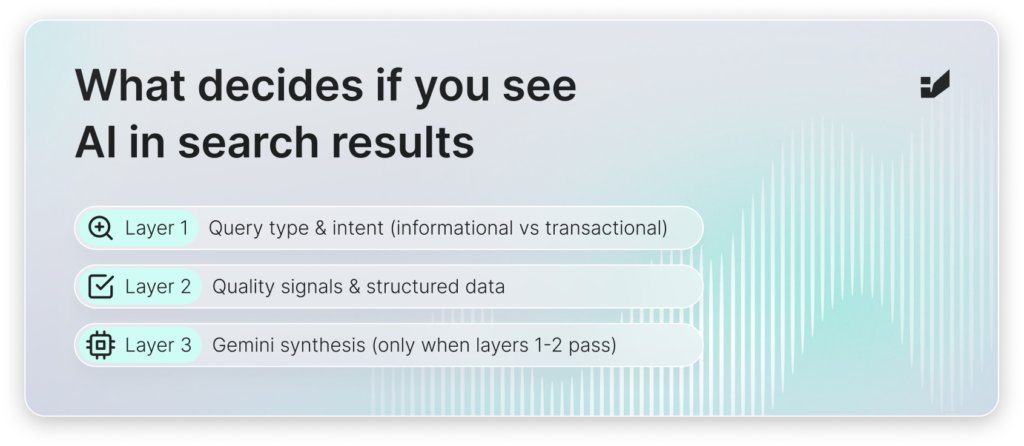
At the technical level, Google’s AI features are powered by advanced models such as Gemini, but these models operate alongside existing systems. They’re layered on top of ranking systems, quality signals, and structured data frameworks.
In AI Overviews, Gemini’s role is primarily generative synthesis – analyzing multiple sources and producing a coherent summary. In AI Mode, the same model supports reasoning, contextual understanding, and conversational continuity.
Crucially, Google doesn’t rely solely on generative AI. Structured data, entity understanding, and traditional ranking signals still determine which sources are eligible to be included in AI-generated responses. In many cases, Google chooses not to generate an answer at all, instead surfacing classic results when AI doesn’t add clear value.
How AI features change user behavior
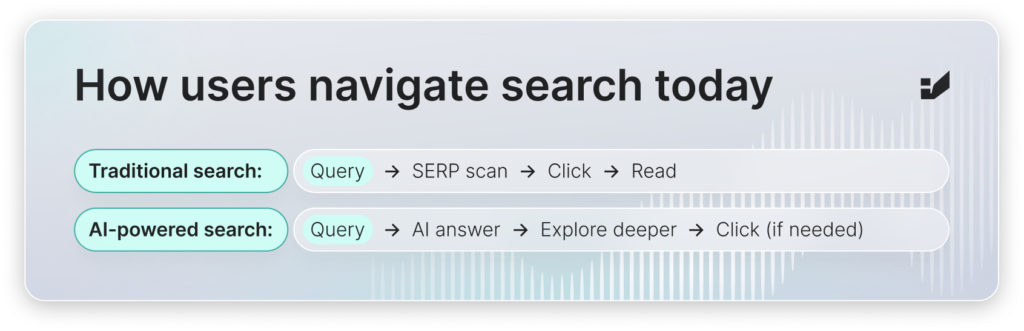
AI-powered search is reshaping how users formulate queries and consume information. Searches are becoming longer, more conversational, and more exploratory. Instead of typing fragmented keywords, users increasingly ask full questions and expect contextual understanding.
This shift often leads to fewer immediate clicks, especially at the top of the funnel. However, it also encourages deeper engagement within the search experience itself. Users may explore multiple angles of a topic before deciding to click through to a source.
For marketers and SEOs, this means traditional CTR benchmarks are becoming less reliable. A drop in clicks doesn’t necessarily indicate a loss of influence – visibility within AI responses may still shape user decisions downstream.
SEO impact: visibility in the age of AI search
One of the biggest concerns around AI Overviews is traffic loss. While some informational queries now result in fewer clicks, the broader impact is more complex.
AI Overviews tend to compress the early research phase. Users still click when they need depth, tools, comparisons, or transactional information. In many cases, AI-driven summaries actually filter traffic, sending fewer but more qualified users to websites.
AI Mode introduces a different dynamic. While it may keep users within Google longer, it can also surface highly relevant sources once intent becomes clearer. The challenge for SEOs is shifting focus from raw traffic volume to strategic visibility and authority.
How to appear in AI Overviews and AI Mode
Getting featured in AI-driven search requires more than traditional keyword targeting. Content needs to be structured, clear, and contextually rich.
Structured data plays a crucial role by helping Google understand entities, relationships, and intent. Clear, concise answers increase the likelihood of being included in AI-generated summaries, especially for definitional and explanatory queries.
Equally important is topical authority. AI systems favor sources that demonstrate consistent expertise across a subject area rather than isolated, thin pages. Anticipating and addressing follow-up questions within your content further increases relevance for conversational search experiences.
Tracking and measuring AI impact
Measuring performance in an AI-driven search environment remains challenging. Google Search Console doesn’t currently provide explicit reporting for AI Overviews or AI Mode, making it difficult to isolate their direct impact.
As a result, SEOs must interpret CTR drops carefully and look beyond traditional metrics. Brand visibility, mentions, and assisted conversions are becoming increasingly important indicators of success.
In practice, this means combining GSC data with broader analytics, brand tracking, and qualitative analysis to understand how AI exposure influences the full user journey.
What comes after AI Overviews and AI Mode?
Google’s trajectory suggests that AI will become the primary interface for search, not just an enhancement layered onto existing results. Search is evolving toward a model where users interact with AI systems that decide how, when, and from whom information is presented.
For publishers and SEOs, long-term success will depend on depth, credibility, and clarity. Short-term tactics may help capture visibility, but sustainable performance will come from being a trusted source that AI systems consistently rely on.
In an AI-first search ecosystem, success comes from being clearly understood, cited as a source, and trusted by users and systems alike.