Content decay in AI Search: How often should you refresh to stay relevant?
Content decay has become a real headache for marketers and content creators. As search engines like Google lean more heavily on AI and algorithms to show relevant results, you need to understand how content decay affects your visibility and rankings.

Key takeaways
- Content decay is the gradual loss of rankings, traffic and AI citations by a page that used to perform well, because its facts, the search intent or the competing pages have changed.
- AI assistants prefer fresher content than Google does. URLs cited by ChatGPT, Perplexity, Gemini and Copilot are on average 25.7% fresher than pages in Google’s organic results (Ahrefs, 17 million citations).
- ChatGPT shows the strongest preference for recent content. Google AI Overviews show almost none and cite pages of a similar age to the organic results.
- Freshness doesn’t replace quality: the average page cited by AI assistants is still almost 3 years old.
- Changing the date without substantial edits doesn’t help. Google explicitly warns against “artificially freshening” pages.
- A workable rhythm: monitor monthly, review priority pages quarterly and set refresh frequency by content type (see the table below).
Every content library loses value over time. Statistics go out of date, products change, competitors publish better answers and search results add new features that take clicks away. In AI search, the effect is stronger: assistants that write answers for users tend to cite more recent sources than Google’s ranked results do. This guide explains what content decay is, how to spot it in your data and how often each type of content should be refreshed.
What is content decay?
Content decay is a steady, multi-month decline in a page’s organic clicks, rankings or AI citations after it has peaked. It is different from a seasonal dip (which returns every year) and from a one-off drop after an algorithm update or a technical error.
One nuance matters more since AI Overviews launched: a page can lose clicks without losing positions. In Pew Research Center’s analysis of 900 US adults’ browsing data, users clicked a regular result in 8% of visits when an AI summary appeared, compared with 15% without one. If your position is stable but your click-through rate is falling, the cause may be the results page, not your content.
Why does content decay happen?
- Facts go stale. Statistics, prices, product versions, screenshots and regulations change, and the page stops being accurate.
- Search intent shifts. The same query starts to call for a different answer or format, such as a comparison instead of a definition. See search intent explained.
- Competitors publish better answers. Newer pages cover the topic more completely or with fresher data.
- The results page changes. AI Overviews, AI Mode and other features answer the question before the user clicks.
- Technical erosion. Broken links, lost internal links, keyword cannibalisation between your own articles, or referring pages that disappear.
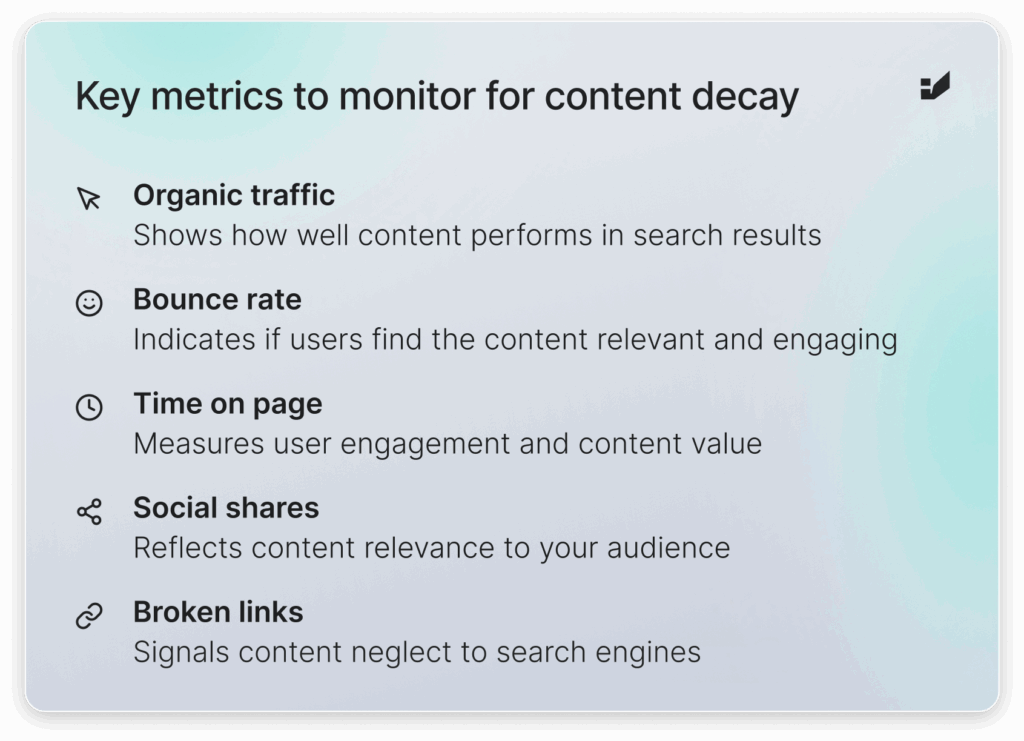
Engagement metrics such as bounce rate or time on page are useful for diagnosis, but they are not signals sent to Google. Google has repeatedly said that it doesn’t use Google Analytics data, including bounce rate, for ranking.
Is AI search more sensitive to content freshness than Google?
Short answer: yes for standalone AI assistants, much less for Google’s AI Overviews.
Ahrefs analysed 17 million citations (July 2025) across ChatGPT, Perplexity, Gemini, Copilot, AI Overviews and Google’s organic results. Pages cited by AI assistants were on average 1,064 days old, compared with 1,432 days for organic results, which makes them 25.7% “fresher”.
| Platform | Age of cited pages compared with Google’s organic results |
|---|---|
| ChatGPT (citations) | 458 days newer |
| ChatGPT (in-text references) | 393 days newer |
| Copilot | 360 days newer |
| Gemini | 298 days newer |
| Perplexity | 250 days newer |
| Google AI Overviews | 16 days older |
Source: Ahrefs, “Do AI assistants prefer to cite fresh content?”, July 2025, based on publication dates of 16.98 million cited URLs.
- Seer Interactive found in server log data that nearly 65% of AI bot hits targeted content published within the past year. The pattern varied by industry: financial services showed an extreme preference for recent content, while evergreen educational topics, such as energy basics, kept attracting AI crawlers for years.
- In a follow-up test, Seer refreshed outdated pages for two clients and recorded a 300% increase in AI traffic for one and a 54% increase in ChatGPT-User bot hits for the other.
- AirOps’ study of 16,851 ChatGPT queries found that pages older than two years were cited less often.
There’s an important caveat. The average page cited by AI assistants is still almost three years old, and Ahrefs itself concludes that freshness is one factor among many. An accurate, well-structured page from 2024 will beat a thin page updated yesterday.
How do you spot content decay on your website?
- Compare periods in Google Search Console. In the Performance report, compare the last three months with the same period a year earlier (to cancel out seasonality) and sort pages by the change in clicks.
- Separate position from click-through rate. A falling position points to decay or stronger competitors. A stable position with falling CTR points to changes in the results page, such as a new AI Overview.
- Go down to query level. Check which queries the page lost. A page often keeps its main keyword but loses the long-tail questions that newer content answers better.
- Check business impact in GA4. Look at engaged sessions and conversions per landing page, so you fix the pages that matter.
- Check AI visibility. Track whether the page is cited for a fixed set of prompts, monitor AI referral sessions (chatgpt.com, perplexity.ai, gemini.google.com, copilot.microsoft.com) and look for AI crawlers such as OAI-SearchBot, ChatGPT-User and PerplexityBot in your server logs. More in metrics that matter in AI search.
- Read the page. Look for outdated statistics, old years in the title, broken links, outdated screenshots and claims that no longer hold.
| Symptom | Likely cause | What to do |
|---|---|---|
| Position falling for main queries | Competitors have better or newer answers | Substantial refresh: new data, new sections, better structure |
| Stable position, falling CTR | AI Overview or other SERP features | Improve title and description, aim to be cited in the AI Overview |
| Losing long-tail queries | Page doesn’t answer newer sub-questions | Add sections and FAQ for the new questions |
| Two of your pages swap positions | Keyword cannibalisation | Merge them and redirect the weaker one (301) |
| Traffic stable, no AI citations | Answers hard to extract, no current data | Answer-first sections, dated facts, question headings |
| Seasonal drop that returns | Seasonality, not decay | Refresh before the season starts |
Tip: a full content audit once a year gives you the baseline that monthly monitoring compares against.
Make your brand visible, from Google to AI chatbots.
How do you refresh content so the update counts?
- Start from the current results. Search the query in Google and ask it in ChatGPT and Perplexity. Note what today’s best answers include that yours doesn’t.
- Update the substance. Replace outdated data with dated, sourced figures, add sections for new sub-questions, and remove parts that are no longer true.
- Put the answer first. Open each section with a direct one- or two-sentence answer and use headings that mirror real questions. See 10 AI search myths for what helps and what doesn’t.
- Show both dates honestly. Keep the original publication date and add a visible “Last updated” date (and dateModified in your structured data), but only after a substantial change.
- Fix the surroundings. Repair broken links, add internal links from newer articles, and merge competing articles with a 301 redirect.
- Get it recrawled. Request indexing in Google Search Console and submit the URL to Bing through IndexNow, since ChatGPT’s search draws on Bing.
- Redistribute it. Share the updated piece through newsletters, social media and sales teams. Mentions across the web also help AI visibility.
What not to do: don’t change the date without changing the content. Google’s guide to helpful content lists changing page dates to seem fresh, without substantial changes, as a warning sign. John Mueller has also said that changing dates alone won’t improve rankings. Avoid adding the new year to the title of an unchanged article, and don’t rewrite pages that still perform well just to stay busy.
Which content is most worth refreshing?
Prioritise by two things: how much the page is worth to the business and how clearly it’s declining.
- Declining pages with business value: pages that bring leads, sales or sign-ups.
- Striking-distance pages: pages ranking roughly in positions 5–20, where a refresh can move them onto page one.
- Pages answering common questions: definitions, comparisons and how-tos that AI assistants are likely to cite.
- Cornerstone content: pillar pages that many other articles link to.
Low-value pages with no traffic, links or conversions are usually better merged into a stronger page or removed than refreshed.
How often should you refresh your content?
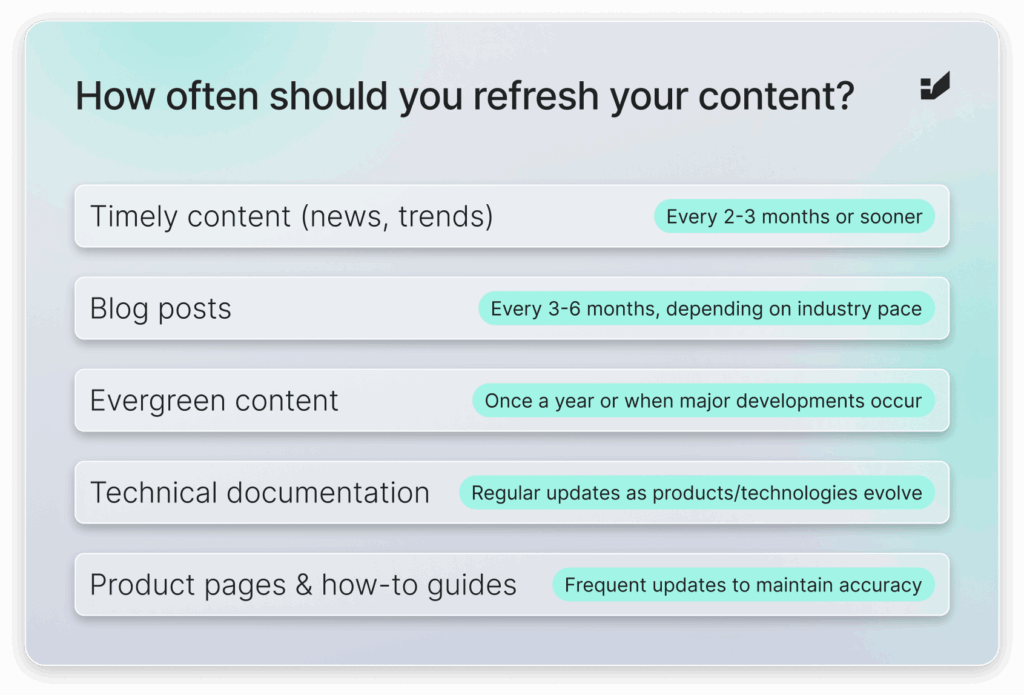
Short answer: review priority pages every quarter and evergreen pages once a year, and refresh as soon as the facts behind a page change. Fast-moving topics such as data roundups, pricing and comparisons need checks every one to three months.
| Content type | Review every | Refresh when |
|---|---|---|
| Statistics and data roundups | 1–3 months | New studies or figures are published |
| “Best X” lists, comparisons (X vs Y), pricing | 1–3 months | Products, prices or rankings change |
| Fast-moving topics (AI search, SEO, technology) | 3 months | Platforms, guidelines or research change |
| Product pages, documentation, software how-tos | 3 months | The product or interface changes |
| Finance, legal and health content | 3 months | Regulations or official guidance change |
| Evergreen guides and definitions | 12 months | Significant developments in the field |
| Case studies | 12 months | Results, client details or links change |
| News | Not refreshed | Link to newer coverage instead |
Treat these intervals as starting points and adjust them using your own decay data. Freshness pays off more in ChatGPT and Perplexity than in Google, and it pays off more in fast-changing industries. Don’t refresh for the sake of it: Ahrefs suggests most brands will get more from creating new, high-quality content than from extremely frequent updates. A refresh is also not a one-off project. See why one-off optimisation doesn’t last.
A simple content refresh workflow
- Monthly: check the Search Console comparison and your AI prompt tracking for pages with declining clicks or citations.
- Monthly: pick 3–5 priority pages using the value × decline criteria above.
- For each page: review current results and AI answers, update the substance, restructure the answers, fix links and update the dates.
- After publishing: request indexing in Google, submit to IndexNow and redistribute.
- After 4–8 weeks: compare clicks, positions and AI citations with the period before the refresh, and note what worked.
- Every year: run a full content audit and adjust the refresh intervals per content type.
Struggling to keep your content fresh and visible? We use data to find decaying content and plan the refreshes that bring traffic back.
FAQ: content decay and content refresh
What is content decay in SEO?
Content decay is a steady, multi-month decline in a page’s organic clicks, rankings or AI citations after it has peaked. It’s usually caused by outdated information, changing search intent, stronger competing pages or changes to the results page, such as AI Overviews.
How often should you update blog content?
Review high-value and fast-moving articles every quarter and evergreen guides once a year. Update immediately when the facts behind a page change, for example new data, new product versions or new regulations. Statistics roundups and comparisons may need checks every one to three months.
Does changing the publication date improve rankings?
No. Google says that changing dates without substantial changes to the content won’t improve rankings, and its helpful content guidance treats it as a warning sign. Update the visible date and dateModified only after a meaningful update.
Do AI assistants prefer fresh content?
Yes, on average. Ahrefs found that pages cited by ChatGPT, Perplexity, Gemini and Copilot are about 25.7% fresher than pages ranking in Google, with ChatGPT showing the strongest preference. Google AI Overviews show almost no extra preference for fresh content.
How do you find decaying content?
Compare the last three months with the same period a year earlier in Google Search Console and sort pages by lost clicks. Then check whether positions or only click-through rates fell, which queries were lost and whether the page is still cited in AI answers.
Should you delete old content?
Only if it has no traffic, links or business value and can’t be improved. Pages that overlap with stronger articles are usually better merged with a 301 redirect, which keeps their links and signals.
Sources
- Ahrefs: New study: AI assistants prefer to cite “fresher” content (17 million citations analyzed) (July 2025)
- Seer Interactive: AI brand visibility and content recency (2025)
- Seer Interactive: Do AI models prefer fresher content? Testing content recency in GEO
- Search Engine Land: ChatGPT citations reward ranking and precision over length (AirOps study) (2026)
- Google Search Central: Creating helpful, reliable, people-first content
- Google Search Central: Influencing your byline dates in Google Search
- Search Engine Journal: John Mueller on changing dates on pages
- Search Engine Journal: Is bounce rate a Google ranking factor?
- Pew Research Center: Google users are less likely to click on links when an AI summary appears (July 2025)
About the author: This article was prepared by the Insightland SEO and GEO team. Insightland is a Wrocław-based agency, part of the Hexe Capital Tech Hub, that connects business, tech and data: SEO and GEO, performance marketing, UX and analytics, and SEO and AI training. Contact us.
more
Related blog posts

Integration of Google Analytics 4 and BigQuery. How much does it cost? Calculator
21 Feb 2023 • Joanna Jelenik