StreetStyle24.pl: +28% increase in top 3 rankings
How we transformed StreetStyle24.pl’s JavaScript rendering into an HTML-first approach – improving search visibility, stabilizing rankings, and driving a +22% surge in top 10 positions within three months.
(01) PROJECT OVERVIEW
From JavaScript barriers to HTML-first success
StreetStyle24.pl partnered with us when facing critical SEO limitations caused by heavy JavaScript rendering. Key site elements – including navigation, product listings, pagination, and internal links – were inaccessible to search engine crawlers in the initial HTML response. After implementing an HTML-first rendering approach for critical elements, the site not only preserved its visibility but achieved significant growth in organic performance within months.
details
Industry
E-commerce / Fashion
Market
Polish
Time
Long-term partnership
Project type
Full-time
Services
Technical SEO, JavaScript Rendering Optimization
(02) Challenge
JavaScript rendering limiting organic growth
When we started working with StreetStyle24.pl, their website was struggling with severe technical issues that were heavily limiting organic performance. The core challenge was JavaScript-dependent rendering for critical site elements, including navigation, menus, sidebar, products, optimization sections (descriptions), pagination, and footer.
This setup created a cascade of SEO problems:
Indexation problems – Not all search engine bots handle JavaScript rendering effectively – this also applies to language models (LLMs). While Google can execute JavaScript, it requires an additional rendering stage (rendering queue), which lengthens the indexation process, and during the first page scan, search engine bots “don’t have access” to all content.
Limited visibility of links and content – If key elements (e.g., menus, product links, or categories) are only available after JS generation, bots may not “see” parts of the site structure. This limits crawling capabilities, indexing of subpages, and link-juice distribution across the site, which can contribute to lower rankings.
Content accessibility for chatbots and AI – LLMs often rely on classic crawls (without JS support or with limited rendering support). If content is generated client-side, chatbots or AI engines may “not see” key sections of the page, limiting the completeness of retrieved data.
All of them directly weakened the organic channel and reduced visibility in competitive fashion e-commerce searches, despite not significantly affecting user experience.
(03) action plan
The strategic approach
Our goal was to improve organic performance by resolving technical rendering issues and making critical content accessible to search engines in the base HTML – without relying on JavaScript execution. The intended outcome was increased visibility, better crawlability, and a foundation for future AI search readiness.
(04) Optimization roadmap
Improvements that drove results
We provided detailed guidelines regarding elements that should be rendered and accessible in base HTML without JS. Working directly with the client, we prioritized:
Improving rendering of key product listing elements (categories) – H1 and category descriptions, products (before implementation, only the first 6 products were rendered without JS), and pagination.
Enhancing internal linking – Making category-level internal links accessible from source HTML, improving crawlability and link equity distribution across category descriptions and product listings.
In the first stage, these elements were prioritized for implementation due to ease and cost of implementation, combined with high potential impact on organic results.
In the long term, we also see potential in improving rendering of other key elements: main menu, sidebar, and footer.
(05) IMPLEMENTATION PROCESS
HTML-first rendering deployment
The first implementation phase was completed on the client side in May 2025:
Product listing optimization
- H1 and category descriptions now render in base HTML
- Full product grids accessible without JavaScript (previously only 6 products)
- Pagination links are visible to crawlers immediately
Internal linking improvements
- Enhanced link equity flow through accessible category descriptions
- Category-to-category links embedded in HTML source
(06) results
Impact in numbers
The results of the implementation exceeded expectations. The site’s visibility in Google increased and stabilized, with fewer fluctuations in visibility and position for key categories. Organic traffic was maintained at a high level, with a clear upward trend driven by improved indexation and optimization.
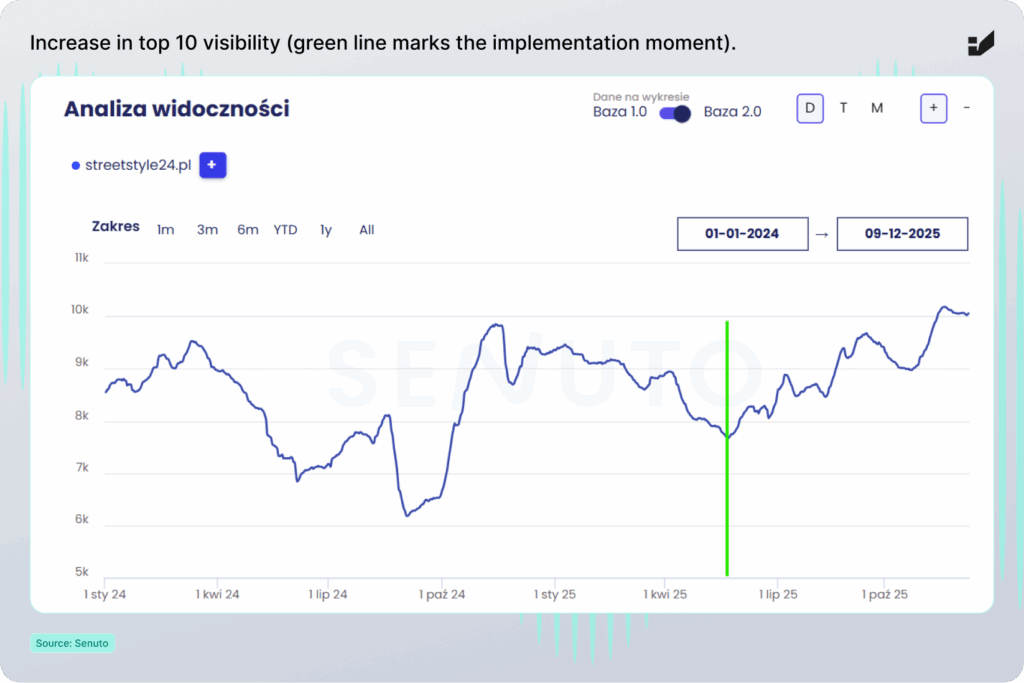
We observed a substantial increase in visibility post implementation. Here’s the comparison of the number of keywords directly before and 3 months after the implementation, based on data from Senuto:
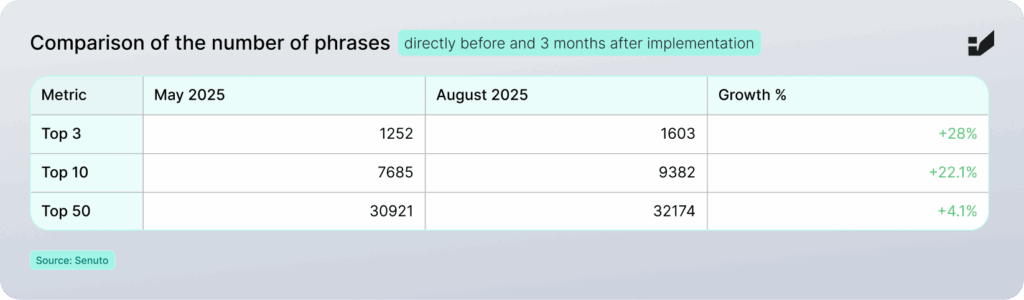
Across all metrics, the upward trend has continued since the beginning of Q3.
Organic Traffic Growth in GA4 – 3 months Y2Y
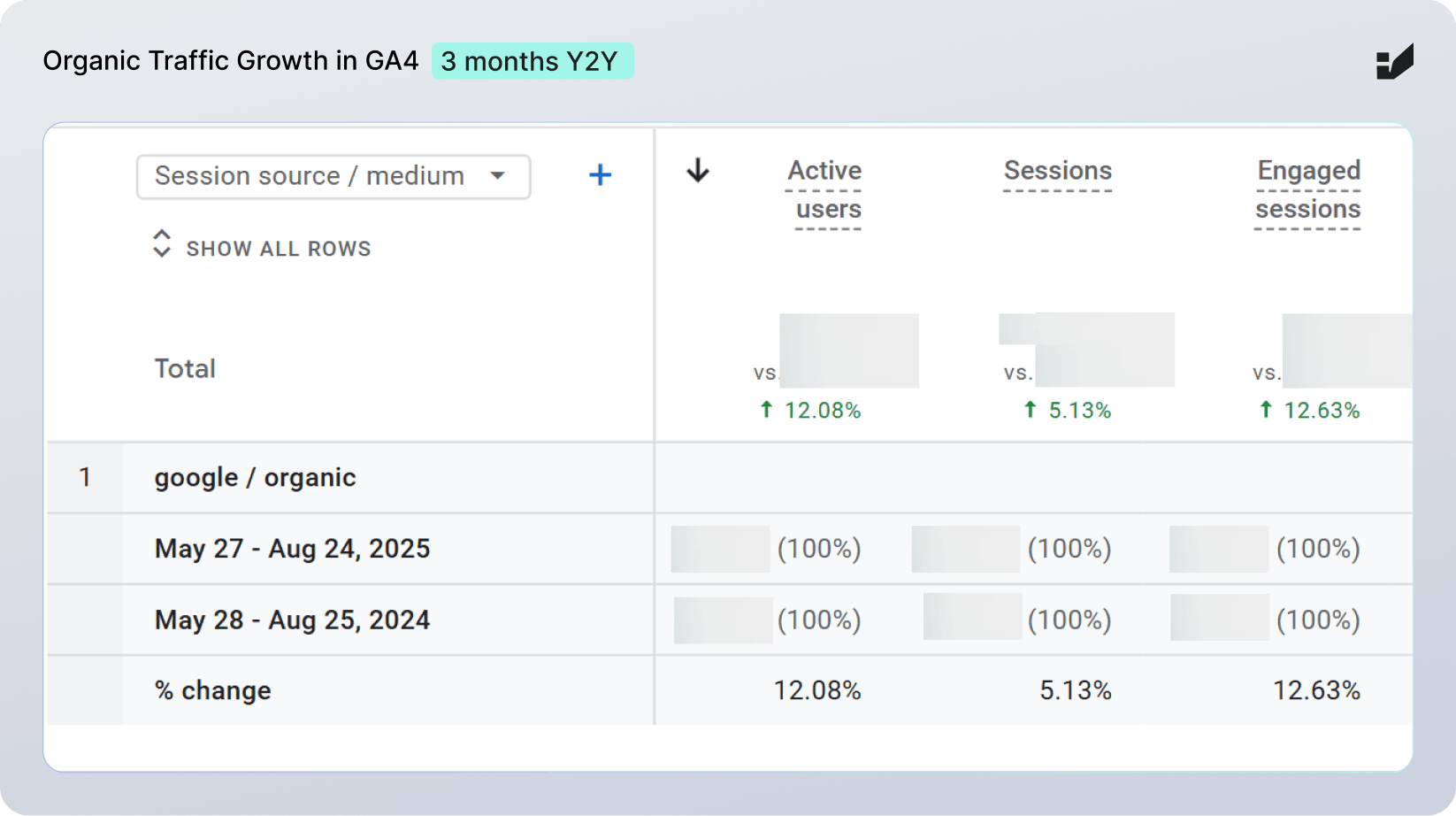
Comparing the last 3 months to the same period in 2024, we observe an increase in organic sessions from Google by over 4%, engaged sessions by over 11%, and active users by nearly 11%.
Business impact
The StreetStyle24.pl rendering optimization is a strong example of how transitioning critical elements from JavaScript to HTML-first can be not only neutral but highly beneficial for SEO.
We’ve achieved these results thanks to a carefully planned process, with SEO priorities integrated throughout the implementation, and handling content and technical elements with precision. The first implementation phase showed that improving rendering of key elements from JS to HTML-first brings real and measurable SEO effects.
This is also a strong foundation for visibility in AI Search, where the presence of content accessible in HTML will be an increasingly important factor in building competitive advantage.