Backlinks in the era of AI Search: Do they still matter in GEO?
Generative search engines like Google AI Overviews, ChatGPT, and Perplexity have become significant channels for content and product discovery. This shift forces brands to reconsider how they build their online presence. Traditional SEO has long depended on backlinks as a primary ranking factor. But with Generative Engine Optimization (GEO) and AI-generated answers, we need to ask whether links carry the same importance.
Key takeaways
- Yes, but they work like a gate, not a dial. Strong link authority is associated with being included in AI answers at all. Once you’re in, brand mentions explain far more about how often you appear.
- Semrush’s study of 1,000 domains found a strong correlation (Pearson 0.65) between link-based Authority Score and being mentioned in AI answers.
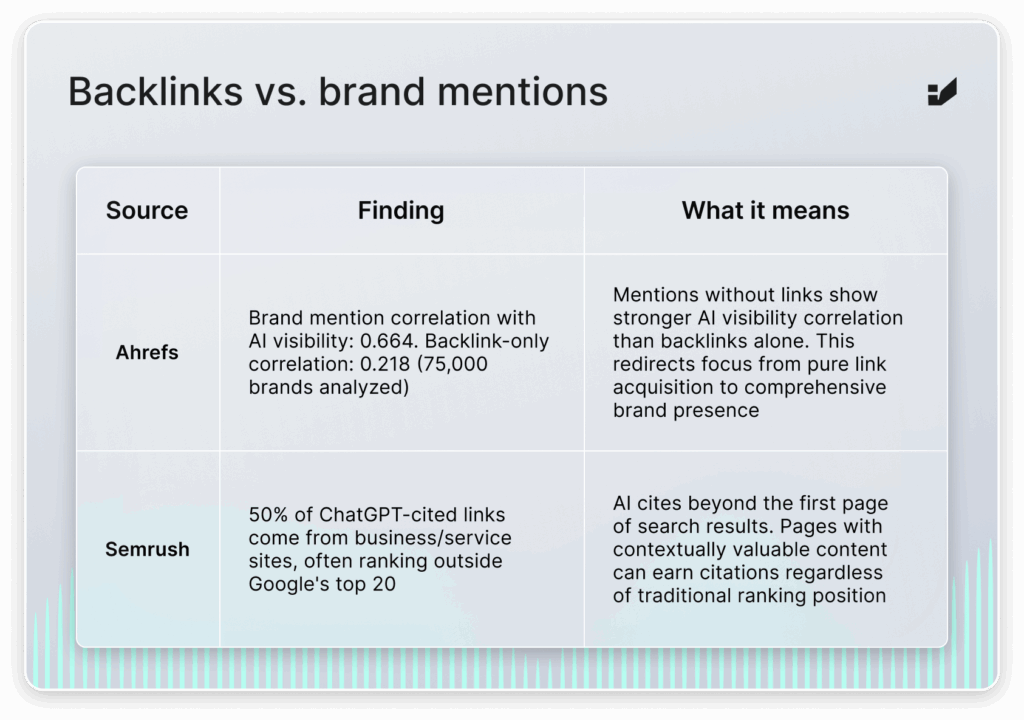
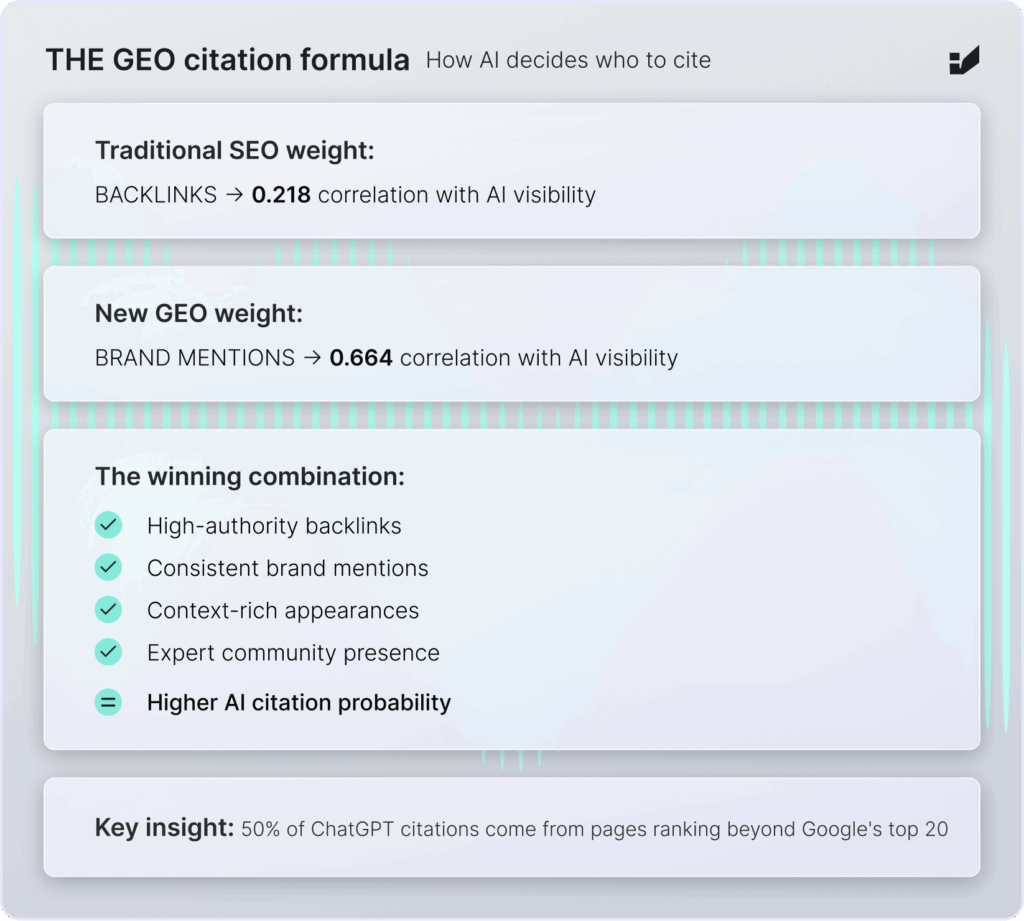
- Ahrefs’ study of 75,000 brands found branded web mentions correlate with AI Overview visibility at 0.664, compared with 0.218 for backlinks.
- In Ahrefs’ December 2025 follow-up across ChatGPT, AI Mode and AI Overviews, YouTube mentions were the strongest signal (about 0.737).
- The best link building for GEO earns links and mentions in places AI systems use: comparisons, industry media, research, reviews, communities and video.
Generative search engines such as Google AI Overviews, AI Mode, ChatGPT and Perplexity have become important channels for discovering content and products. Traditional SEO has long relied on backlinks as one of its strongest signals. With generative engine optimization (GEO), the question is whether links still carry the same weight, or whether something else now matters more. This article looks at what the research shows, which links and mentions matter for AI visibility, and how to build and measure them.
Make your brand the answer, across every search channel.
GEO in brief
Generative engine optimization (GEO) aims to make your brand visible in AI-generated answers. SEO aims for high rankings; GEO aims for your brand to be cited and recommended inside the answer. Rankings still matter, but so do the consistency and context of mentions across trusted sources, from industry publications to community forums. For the full picture, see our GEO guide.
How do AI systems decide what to include in their answers?
Generative engines don’t show a ranked list. They retrieve candidate sources, decide which are relevant and credible, and write an answer that cites some of them. Each system draws on a slightly different pool:
- Google AI Overviews and AI Mode draw on Google’s index and search for several related sub-queries. In early 2026, only 38% of AI Overview citations came from pages ranking in the top 10 for the original query.
- ChatGPT answers from its training data and, for part of its answers (34.5% of queries in February 2026), from a live web search using third-party providers including Bing. Wikipedia was its most cited domain in a Profound analysis of 680 million citations.
- Perplexity runs its own index and cites heavily. It is the assistant whose citations overlap most with Google’s top 10 (28.6%), and it leans on community platforms, although Reddit’s share of its citations fell from 25% to 7% between February and April 2026.
Repetition and context build influence
One mention rarely changes anything. AI systems more often name brands that appear consistently across trusted contexts: comparison articles, industry reports, reviews and community discussions. Co-citations, meaning regular appearances alongside competitors or key category terms, help AI place your brand in the right category. That’s why the web of contexts in which your brand appears matters more than the raw number of backlinks.
Backlinks vs brand mentions: what does the data show?
| Study | What was measured | Key results |
|---|---|---|
| Ahrefs, May 2025 (75,000 brands) | Correlation of off-site factors with brand mentions in AI Overviews | Branded web mentions 0.664; branded anchors 0.527; branded search volume 0.392; Domain Rating 0.326; referring domains 0.295; backlinks 0.218 |
| Ahrefs, Dec 2025 (75,000 brands) | The same factors across ChatGPT, AI Mode and AI Overviews | YouTube mentions ~0.737; branded web mentions 0.656–0.709; branded anchors 0.511–0.628 |
| Semrush, 2025 (1,000 domains) | Link-based Authority Score vs mentions in ChatGPT, Gemini, AI Overviews and Perplexity | Pearson 0.65, Spearman 0.57; big gains only in the highest authority tiers |
| Semrush, same dataset | Authority vs share of voice once a domain already appears | Pearson about 0.23; follow and nofollow links correlated almost equally |
What does this mean?
- Links open the door. Domains with strong link profiles are much more likely to be in the pool AI systems draw on. Search indexes still rely on links, and AI systems still retrieve pages through search.
- Mentions decide your share. Once you’re in, how often and where your brand is talked about explains far more of your visibility than additional links do.
- Video and communities count. YouTube mentions and community discussions are among the strongest correlates of AI visibility across platforms.
- These are correlations. Strong brands earn links, mentions and AI visibility at the same time. Treat the numbers as direction, not as a formula.
What kind of links matter for GEO?
1. Quality over volume
Directory submissions, private blog networks and paid link schemes don’t help, and they breach Google’s spam policies. Semrush found that visibility gains appear mainly at the highest authority tiers, which are built by editorial links from respected sites, not by link count.
2. Relevance and topical alignment
Links and mentions from content closely related to your field, such as industry reviews, market reports and specialist media, reinforce what your brand is about. They also support your topical authority.
3. Source and author credibility
Links from sources with clear expertise and reputation carry more weight with search engines and are the kind of sources AI systems cite. See E-E-A-T in AI search.
4. Links that confirm relationships between entities
Consistent appearances in rankings, comparisons and reports alongside competitors show which category you belong to. Branded anchors, links that use your brand name, correlated with AI visibility at 0.51–0.63 in Ahrefs’ data.
5. Placement in the main content
Links and mentions inside the body of an article, in context, are more meaningful than footer, sidebar or author bio links. They are also more likely to sit in the passage that AI systems retrieve.
Summary: a link from a respected, relevant source, placed in the main content and surrounded by other credible references, does more for AI visibility than many weak links.
Which link-building strategies work in the AI era?
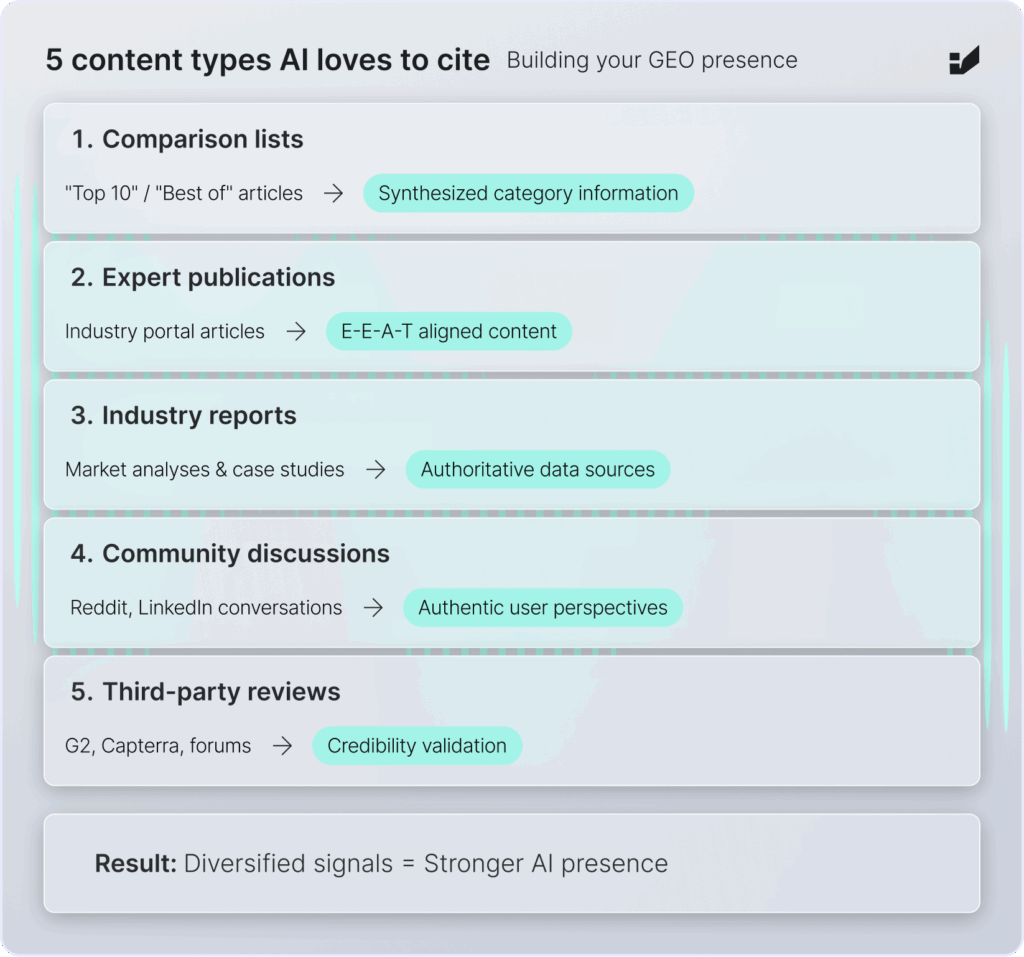
Links and mentions work best when they build a consistent picture of your brand across the sources AI systems use:
- Comparisons and “best of” lists. Roundups place brands in a category and are frequently retrieved for recommendation questions.
- Editorial articles and expert commentary. Pieces in industry portals and recognised media, signed by experts, carry more weight than your own blog.
- Industry reports and research. Original data earns links and mentions naturally and gives AI systems something worth citing.
- Community discussions. Reddit and LinkedIn were among the most cited domains across ChatGPT Search, AI Mode and Perplexity in a Semrush analysis of 325,000 prompts. Take part genuinely; don’t spam.
- Reviews and third-party feedback. Review platforms such as G2, Capterra and industry forums validate your claims.
- Video. Mentions in YouTube titles, descriptions and transcripts were the strongest correlate in Ahrefs’ December 2025 study. Reviews, tutorials and interviews on YouTube count.
Avoid shortcuts. Google’s AI features guide warns that seeking inauthentic mentions isn’t as helpful as it might seem.
Make your brand visible, from Google to AI chatbots.
How do you measure link building in GEO?
The question changes from “did we get the link?” to “are we mentioned and cited more often in AI answers?”
- Prompt testing. Ask ChatGPT, Gemini, Perplexity and Google AI Mode the questions your customers ask, several times each. Record whether your brand appears, which sources are cited and which competitors are named.
- AI visibility tools. Tools such as Semrush’s AI Visibility Toolkit or Ahrefs Brand Radar track brand mentions and citations across AI platforms and compare you with competitors.
- Linked and unlinked mentions. Monitor where your brand is mentioned on the web, with or without a link.
- Classic link metrics. Referring domains and links from relevant, authoritative sites still matter for rankings and for getting into the AI candidate pool.
Track trends over months, not single checks. Read more in metrics that matter in AI search.
Practical guidelines for link building in AI search
Create content that answers real questions
Pages that clearly answer the questions people ask attract links and get retrieved by AI systems. Plan content around questions and intent, not single keywords.
Keep structured data accurate, but don’t rely on it
Organization and Review markup help search engines understand your entity. But Google retired HowTo rich results in 2023 and FAQ rich results in May 2026, and a controlled Ahrefs study found no citation lift from adding schema. See structured data in AI search.
Build an authority network
AI systems pick up patterns: who talks about your brand, in which contexts and how often. Mentions in reports, comparisons and industry forums can matter as much as a link from a high-authority domain.
Think reputation, not individual links
Links, mentions, reviews and community discussions together form the profile AI systems use to describe you. See how to control what AI says about your brand.
Ready to make your search engine understand your users?
The path forward for backlinks and AI search
Do backlinks still matter in AI search? Yes. They help you rank, help search systems find and trust you, and are strongly associated with being included in AI answers. But once you’re in the candidate pool, brand mentions in trusted contexts explain much more of how often you appear. Winning in AI search means combining:
- editorial backlinks from authoritative, relevant sources;
- consistent brand presence in reports, comparisons, reviews, communities, media and video;
- deliberate reputation-building through expertise and E-E-A-T signals.
Link building becomes one part of a broader strategy for being recognised, and recommended, across the AI ecosystem. See also whether rankings still matter for AI search.
Boost sales with SEO + GEO.
FAQ: backlinks and AI search
Do backlinks still matter for AI search?
Yes. Semrush found a strong correlation (Pearson 0.65) between link-based authority and being mentioned in AI answers. But once a domain appears, additional authority explains much less of how often it’s mentioned, and brand mentions become more important.
Are brand mentions more important than backlinks for AI visibility?
In Ahrefs’ study of 75,000 brands, branded web mentions correlated with AI Overview visibility at 0.664, compared with 0.218 for backlinks. Mentions don’t replace links, but they matter more for how often AI names your brand.
Do unlinked brand mentions help AI visibility?
Yes. Ahrefs counted mentions with and without links, and both were among the strongest correlates of AI visibility. AI systems learn about brands from text, so being discussed matters even without a hyperlink.
Which sources matter most for AI visibility?
Studies point to Wikipedia-type references, community platforms such as Reddit and LinkedIn, YouTube, review sites, industry media and research. In Ahrefs’ December 2025 study, YouTube mentions had the strongest correlation with AI visibility (about 0.737).
Do nofollow links help with AI search?
In Semrush’s data, follow and nofollow links correlated with AI visibility almost equally. For AI systems, a mention in a relevant, credible context matters more than the link attribute.
How do I measure the effect of link building on AI visibility?
Track brand mentions and citations for a fixed set of prompts across AI tools over time, monitor linked and unlinked mentions on the web, and compare the trend with your link-building activity.
Sources
- Ahrefs: An analysis of AI Overview brand visibility factors (75K brands) (May 2025)
- Ahrefs: Top brand visibility factors in ChatGPT, AI Mode and AI Overviews (Dec 2025)
- Semrush: Do backlinks still matter in AI search? Insights from 1,000 domains (2025)
- Something Inc.: Backlinks in AI search, a gate not a dial (2026)
- Ahrefs: Only 12% of AI cited URLs rank in Google’s top 10 (Aug 2025)
- DesignRush: only 38% of AI Overview citations come from top 10 pages (Mar 2026)
- BuzzStream: most cited sites in ChatGPT (Profound data) (2025)
- eMarketer: Reddit is the top cited domain across ChatGPT Search, AI Mode and Perplexity (Semrush) (2026)
- Google Search Central: Spam policies
- Google Search Central: Optimizing your website for generative AI features (May 2026)
About the author: This article was prepared by the Insightland SEO and GEO team. Insightland is a Wrocław-based agency, part of the Hexe Capital Tech Hub, that connects business, tech and data: SEO and GEO, performance marketing, UX and analytics, and SEO and AI training. Contact us.