AI Search optimization for brand safety: How to control what AI says about you
Language models are becoming a new source of knowledge and brand recommendations. The problem is that their answers can be incomplete, outdated, or entirely incorrect, and users rarely verify their reliability.
Key takeaways
- AI assistants regularly get facts wrong. In an EBU and BBC study of more than 3,000 answers, 45% had at least one significant issue, and 20% contained inaccurate or outdated information.
- Most errors about brands come from the sources models learn from or retrieve: outdated pages, a single incorrect article, missing information or confusion with similar names.
- You can’t control AI answers directly, but you can influence the sources they rely on: your own site, review platforms, Wikipedia-type references, media and communities.
- Start with an audit: ask the same set of questions about your brand in ChatGPT, Gemini, Perplexity and Google AI Mode, several times, and log every error and its likely source.
- Corrections take time. Errors from live web search can disappear within weeks once sources are fixed, while errors learned during model training can persist until the next model update.
Language models have become a new source of brand information and recommendations. ChatGPT alone has 900 million weekly users, and many of them ask it which product to buy, which agency to hire or whether a company is trustworthy. The problem is that answers can be incomplete, outdated or simply wrong, and users rarely check them. Brand safety in AI search means making sure that, when AI talks about your brand, it gets the facts right and reflects your real strengths.
Let your customers find you, wherever they look.
Why does it matter what AI says about your brand?
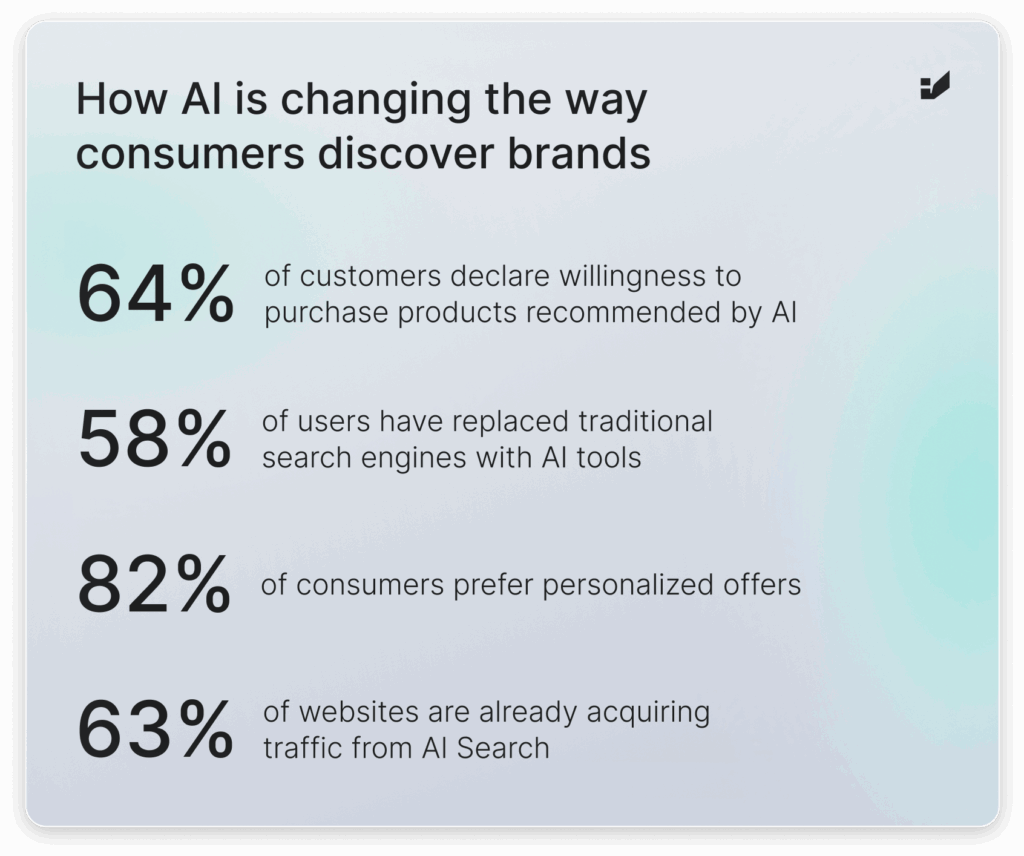
- AI is becoming a first point of contact. In a Capgemini survey of 12,000 consumers, 58% said they had replaced traditional search engines with generative AI tools as their go-to source for product and service recommendations, and three-quarters were open to AI recommendations.
- AI answers are often wrong. In the EBU and BBC study of more than 3,000 answers from ChatGPT, Copilot, Gemini and Perplexity (October 2025), 45% had at least one significant issue, 31% had sourcing problems and 20% contained inaccurate or outdated information.
- AI sounds confident even when it’s wrong. The Tow Center for Digital Journalism found that AI search tools gave incorrect answers to more than 60% of its test queries, and rarely signalled uncertainty.
The consequences are simple. If your brand doesn’t appear in AI answers, it doesn’t make the shortlist. If it appears with outdated or incorrect information, you lose trust before a customer ever visits your website.
Where do AI assistants get information about brands?
Training data
Models are trained on large collections of text: websites, articles, books, forums, reviews and documentation. This forms their general knowledge, including what they “know” about your brand. It is updated only when a new model is trained, so it can be months or years out of date.
Live web search
ChatGPT, Gemini, Perplexity, Copilot and Google’s AI features can search the web and cite what they find. ChatGPT doesn’t do this every time: Semrush data shows it ran a web search for 34.5% of queries in February 2026. Questions about well-known brands are often answered from memory.
The sources they prefer
Assistants lean heavily on a few types of sources: encyclopaedic references such as Wikipedia (the most cited domain in ChatGPT in a Profound analysis of 680 million citations), community platforms such as Reddit, review sites such as G2, Capterra or Trustpilot, media and industry blogs, YouTube and the brands’ own websites. Their weight shifts quickly: Reddit’s share of Perplexity citations fell from 25% to 7% between February and April 2026.
Why errors happen
| Type of error | Typical cause |
|---|---|
| Outdated facts (old prices, discontinued products, former management) | Old pages still online, training data from before the change |
| False claims (“no customer hotline”, “no shipping to Poland”) | A single incorrect source, often an external article or review |
| Confusion with another brand | Similar names, weak or inconsistent brand identity across the web |
| Missing strengths | No independent sources confirming them |
| Negative bias | Old complaints dominate because there are few recent reviews |
| Hallucinated details | No reliable information, so the model fills the gap |
Case study: how one article taught a chatbot that a brand had no hotline
One of our clients, a mobile network operator with consistent communication and a distinctive tone of voice, was generally described positively by AI assistants. With one exception: when asked for an opinion about the brand, one chatbot repeatedly claimed that the operator had no customer hotline. The hotline number was clearly shown on the client’s website.
We traced the claim to a single external publication that contained the incorrect information. The brand’s website and the rest of its ecosystem confirmed the hotline, but the model kept relying on that one flawed source.
The lesson: what AI says about you depends not only on your own website but on every source it can find. A single wrong page can outweigh many correct ones if it answers the question more directly.
How to audit what AI says about your brand
A brand audit in AI search works best with a fixed set of questions in four groups:
| Question type | Example prompts | What you check |
|---|---|---|
| Factual | “Who owns <brand>?”, “Does <brand> offer <service>?”, “Where is <brand> based?” | Accuracy of key facts |
| Perception | “What is <brand> known for?”, “What do customers say about <brand>?” | Strengths, weaknesses, tone |
| Comparison | “<brand> vs <competitor>: which is better for <need>?” | How you’re positioned against rivals |
| Non-brand | “Which companies offer <service> in <country>?” | Whether you’re recommended at all |
- Prepare 20–60 prompts across the four groups, phrased the way your customers ask.
- Run each prompt several times in ChatGPT, Gemini, Perplexity, Copilot and Google AI Mode. Answers vary between runs, so single tests mislead.
- Log every factual error, missing strength, negative claim and the competitors named.
- Where the answer cites sources, note them. Where it doesn’t, search for the claim to find where it may come from.
- Prioritise errors by business impact: wrong prices, availability, contact details and safety claims come first.
For ongoing tracking, use an AI visibility monitoring tool and repeat the audit every month. See metrics that matter in AI search.
How to correct what AI says about your brand
You can’t edit an AI answer directly. You can change the information the model finds and learns from. A systematic approach combines content, technical and reputation work.
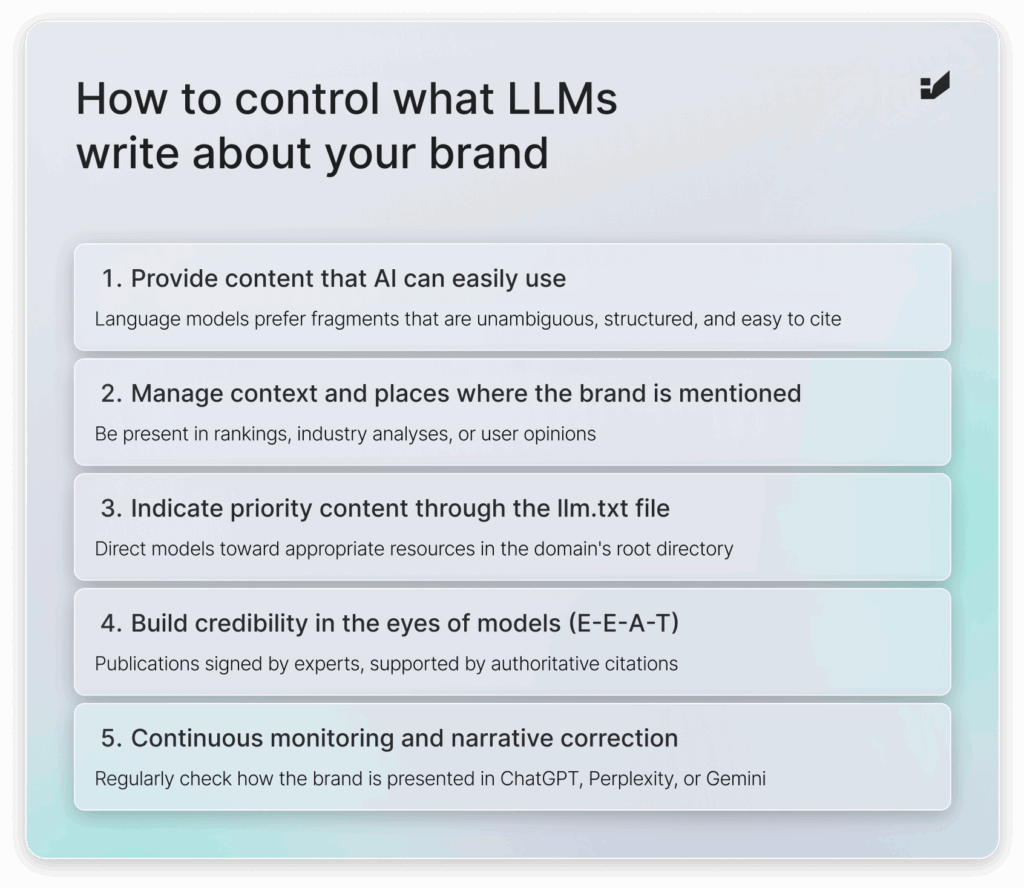
1. Publish the facts clearly on your own site
Create or update pages that state key facts in plain sentences: who you are, what you offer, where you operate, prices or price ranges, contact and support options, and answers to common questions. Use headings that match the questions people ask, and keep the facts consistent across every page. Clear, specific statements are easier for AI systems to retrieve and repeat correctly.
2. Fix the sources behind the errors
If an external article, directory or review contains wrong information, contact the publisher and ask for a correction. Update your profiles on review sites, directories, marketplaces and social platforms. Remove or redirect outdated pages on your own site, such as old price lists or discontinued products.
3. Strengthen the places where your brand is discussed
Brands that are widely and consistently mentioned are described more accurately. In Ahrefs’ study of 75,000 brands, web mentions were the strongest correlate of AI Overview visibility. Encourage genuine reviews, take part in industry discussions, appear in rankings and analyses, and keep reference sources such as Wikipedia-type entries accurate where your brand is notable enough to have one. Read more about mentions in GEO.
4. Show who stands behind your content
Sign content with real experts, cite sources and show publication and update dates. Use Organization structured data with links to your official profiles to help search engines connect your brand’s entities, but don’t expect markup alone to change AI answers. See E-E-A-T in AI search.
5. Make sure AI crawlers can reach your pages
Check that your robots.txt and CDN settings allow search and AI crawlers such as Googlebot, Bingbot, OAI-SearchBot and PerplexityBot. If they can’t reach your correct information, they will rely on other sources.
6. Treat llms.txt as optional
An llms.txt file in your root directory can list your key pages, but it is not a way to control what AI says. Google doesn’t use it, no major AI provider has confirmed relying on it, and Google’s John Mueller has said such files can’t help LLMs decide which sites to surface. See our llms.txt guide and what we learned after implementing it.
7. Monitor and repeat
Re-run your prompt set after each change. Keep facts fresh, because AI assistants prefer recently updated content. See content decay in AI search.
| Error | First action | Supporting actions |
|---|---|---|
| Outdated fact | Update or redirect old pages on your site | Update external profiles; publish a dated update |
| False claim from one source | Ask the publisher for a correction | Publish a clear statement of the fact on your site; earn correct mentions elsewhere |
| Confusion with another brand | Make brand name, description and identifiers consistent everywhere | Organization schema with official profile links; distinctive descriptions |
| Missing strengths | Publish evidence: case studies, data, awards | Get independent coverage and reviews that confirm them |
| Negative bias | Respond to complaints and fix underlying issues | Encourage recent reviews from satisfied customers |
How long does it take for AI answers to change?
It depends on where the error comes from. When an assistant takes the information from a live web search, correcting the source can change the answer within weeks, once the corrected page is recrawled. When the error is part of what the model learned during training, it can persist until the provider releases an updated model. That’s why the fastest fixes target cited sources, and why long-term brand safety depends on many consistent, correct sources across the web.
Ready to find out what AI says about your brand?
Next steps for brand protection in AI
AI assistants now recommend brands, not just find them. Brands that ignore what AI says about them risk losing customers to outdated or false information. Brands that audit, correct and monitor their presence become the accurate, confident answer AI gives. Start with one audit of your most important questions, fix the errors with the highest business impact, and repeat every month.
Boost sales with SEO + GEO.
FAQ: brand safety in AI search
How do I find out what ChatGPT says about my brand?
Ask ChatGPT the questions your customers ask about your brand, such as what you offer, how you compare with competitors and what customers say about you. Repeat each question several times and in other assistants, because answers vary. For regular tracking, use an AI visibility monitoring tool.
Can I ask OpenAI or Google to correct wrong information about my company?
There is no general process for brands to edit AI answers. You can use the feedback buttons in AI tools, but the reliable fix is to correct the sources the AI relies on: your website, external articles, profiles and reviews.
Why does AI say incorrect things about my brand?
Usually because a source it relies on is wrong or outdated, because there isn’t enough consistent information about your brand online, or because it confuses you with a similarly named company. When it lacks reliable information, it may also invent details.
How long does it take to fix AI misinformation about a brand?
Errors that come from live web search can disappear within weeks after the source is corrected and recrawled. Errors learned during model training can persist until the provider releases an updated model.
Does llms.txt control what AI says about my brand?
No. Google doesn’t use llms.txt, and no major AI provider has confirmed relying on it. It can list your key pages, but accurate content, consistent external sources and crawl access matter far more.
Which sources influence AI answers about brands the most?
Studies of AI citations point to Wikipedia-type references, community platforms such as Reddit, review sites, major media and industry publications, YouTube and brands’ own websites. The mix differs between assistants and changes over time.
Sources
- MediaPost: EBU and BBC study, AI assistants provide answers full of errors (Oct 2025)
- Nieman Lab: Tow Center study, AI search engines fail to produce accurate citations in over 60% of tests (Mar 2025)
- Capgemini: What matters to today’s consumer 2025 (Jan 2025)
- TechCrunch: ChatGPT reaches 900M weekly active users (Feb 2026)
- MediaPost: Semrush study of ChatGPT search behaviour (2026)
- Ahrefs: AI Overview brand visibility factors, 75K brands (2025)
- BuzzStream: most cited sites in ChatGPT (Profound data) (2025)
- Search Engine Land: Google says llms.txt won’t be used (2025)
- Let’s Data Science: Mueller on llms.txt (2026)
- Ahrefs: AI assistants prefer to cite fresher content (Jul 2025)
About the author: This article was prepared by the Insightland SEO and GEO team. Insightland is a Wrocław-based agency, part of the Hexe Capital Tech Hub, that connects business, tech and data: SEO and GEO, performance marketing, UX and analytics, and SEO and AI training. Contact us.