Measuring success in AI Search: metrics that matter
In this article, we explain how to assess content performance in the era of AI-driven search.

Key takeaways
- Measure AI search on three levels: visibility (are you mentioned or cited?), perception (how are you described?) and business impact (do AI visitors convert?).
- Free first-party data now exists: Search Console’s Generative AI report (impressions in AI Overviews and AI Mode), Bing’s AI Performance report (Copilot citations) and GA4’s AI Assistant channel.
- AI answers are unstable. The same brand list appears in fewer than 1 in 100 repeated runs (SparkToro), so track the share of answers that mention you across many prompts and runs, not a single “position”.
- Mentions and citations are different metrics. Being named in the answer builds awareness; being linked as a source drives traffic. Track both.
- Report trends monthly, against competitors and a fixed prompt set, alongside classic SEO metrics.
Classic SEO metrics show only part of the picture. Google AI Overviews and AI Mode, ChatGPT, Gemini, Perplexity and Copilot answer questions directly, and users often don’t click: AI Overviews reduce the click-through rate of the top result by about 58% (Ahrefs). Your brand can influence a decision without a single visit.
This article explains which metrics to track, how to calculate them, which data you can get for free from Google, Bing and GA4, and how to build a simple AI search report.
Make your brand visible, from Google to AI chatbots.
Where can you get AI search data?
| Source | What it shows | Limits |
|---|---|---|
| Google Search Console: Generative AI report (since June 2026) | Impressions of your pages in AI Overviews and AI Mode, by page, country, device and date | No clicks or queries; AI Overviews and AI Mode combined |
| Bing Webmaster Tools: AI Performance (since Feb 2026) | Citations in Microsoft Copilot and Bing AI answers, cited pages and grounding queries | No clicks; Microsoft surfaces only |
| GA4: AI Assistant channel (since May 2026) | Sessions, engagement and key events from recognised AI assistants such as ChatGPT, Gemini and Claude | Only visits with a referrer; others appear as Direct |
| ChatGPT UTM tagging | ChatGPT adds utm_source=chatgpt.com to many links it shows | Not on every link; tagging rates vary |
| AI visibility tools | Mentions, citations, share of voice and sentiment across ChatGPT, Gemini, Perplexity, AI Overviews and others, for your prompt set | Results depend on prompts, location and number of runs |
Common AI visibility tools include Semrush AI Visibility Toolkit, Ahrefs Brand Radar, Profound, Peec AI, Otterly.AI, seoClarity and Mangools AI Search Watcher. Insightland also runs AI visibility audits that track how AI assistants describe and recommend a brand.
Why do AI search metrics need a different method?
A Google ranking is fairly stable; an AI answer is not. In a SparkToro and Gumshoe study (January 2026), ChatGPT and Google’s AI returned the same list of brands in fewer than 1 in 100 repeated runs of the same prompt, and the same list in the same order in fewer than 1 in 1,000. What was more stable was how often a brand appeared across many runs.
What this means in practice:
- build a fixed set of prompts (typically 30–100) that reflects real customer questions: category, comparison, problem and brand prompts;
- run each prompt several times per platform and per measurement period;
- report the percentage of answers that mention or cite you, not a “rank”;
- keep the prompt set, platforms and location the same over time, so that changes reflect your work, not your method.
Which AI search metrics matter?
| Metric | What it measures | How to calculate | Where to get it |
|---|---|---|---|
| 1. AI Overview / AI Mode presence | How often your pages appear in Google’s AI answers | AI impressions per page and over time | Search Console Generative AI report |
| 2. Citation frequency | How often your pages are linked as sources | Answers citing your domain ÷ all answers in the panel | Bing AI Performance, AI visibility tools |
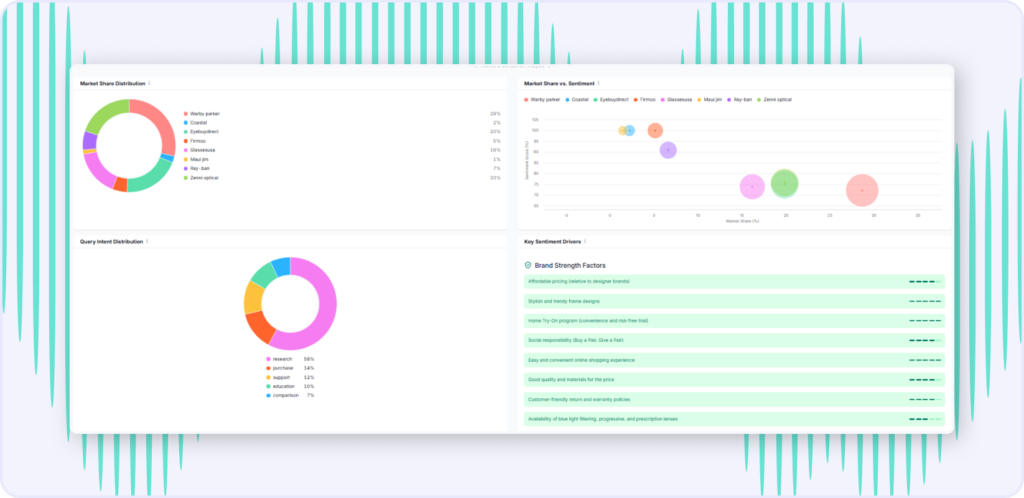
| 3. Share of voice (SOV) | Your share of mentions vs competitors | Your mentions ÷ mentions of all tracked brands | AI visibility tools |
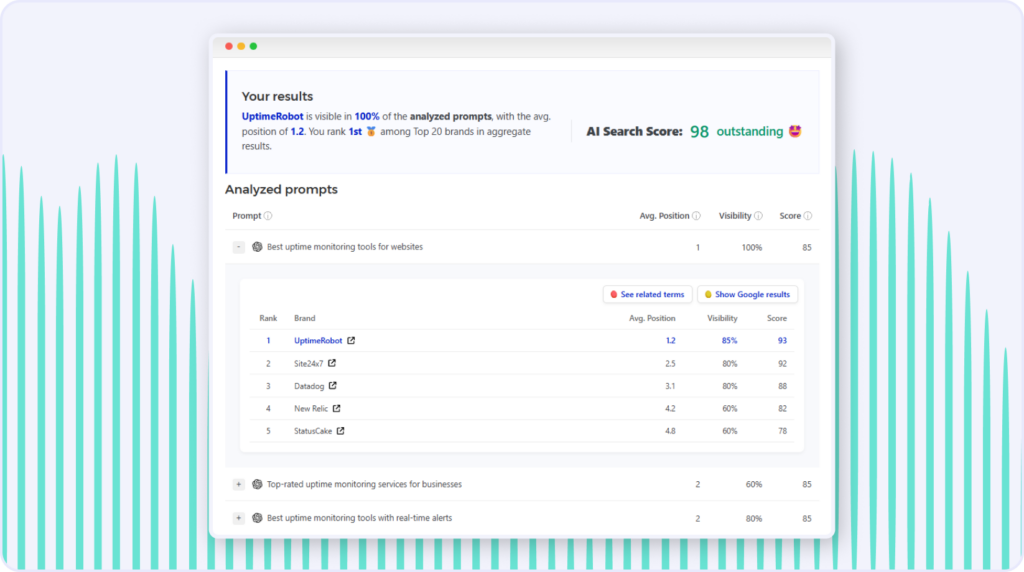
| 4. AI visibility score | A composite of mentions, citations and prominence | Weighted index defined by your tool; use for trends only | AI visibility tools |
| 5. Sentiment and accuracy | How AI describes your brand, and whether it’s correct | % of answers that are positive / neutral / negative, and % with factual errors | Tool + manual review |
| 6. Volatility | How stable your presence is | Change in mention rate between periods, per platform | Your panel data over time |
| 7. AI traffic engagement | What AI visitors do on your site | Engagement rate, pages per session, key event rate | GA4 AI Assistant channel |
| 8. Topic association | Which topics AI connects with your brand | Mention rate per topic cluster | Panel grouped by topic |
| 9. AI-driven conversions and revenue | Business impact | Key events and revenue from AI channel | GA4, CRM |
1. AI Overview and AI Mode presence
Search Console’s Generative AI report shows how often links to your pages appeared in AI Overviews and AI Mode. Use it to find which pages Google uses as sources and how that changes after content updates. It doesn’t show clicks or queries, so pair it with the standard Performance report.
2. Citation frequency
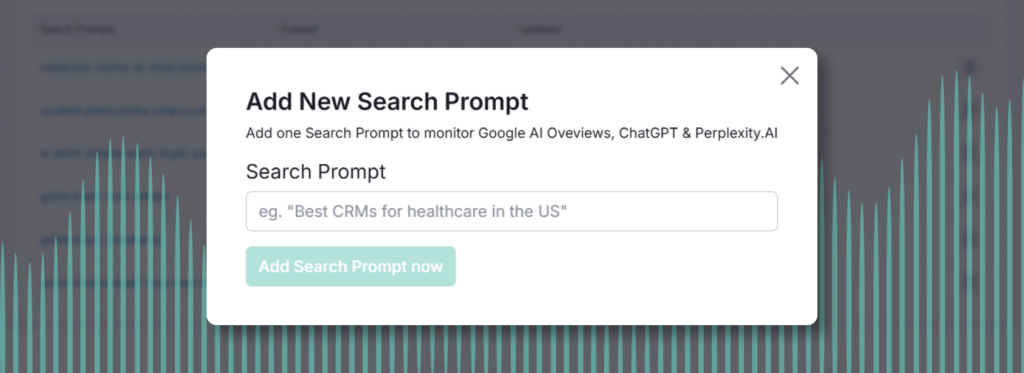
A citation is a link to your page as a source; a mention is your brand named in the text. Both matter, and they don’t always go together. Research-backed, specific pages are cited most often, and brand mentions across the web are strongly correlated with AI visibility (0.664 in Ahrefs’ study). See backlinks and mentions in GEO.
3. Share of voice
Share of voice compares your mentions with those of competitors for the same prompts. Track it by topic and platform: a brand can lead in ChatGPT and be absent from AI Overviews.
4. AI visibility score
Many tools combine mentions, citations, prominence and sentiment into a single score. It’s useful for trends, but formulas differ between tools, so don’t compare scores across tools.
5. Sentiment and accuracy
Check not only whether AI mentions you, but what it says. In the EBU and BBC study (October 2025), 45% of AI assistant answers had at least one significant issue. Track outdated prices, discontinued products and wrong facts, and fix them at their sources. See how to control what AI says about your brand.
6. Volatility
Expect fluctuations between runs and weeks. Look for sustained changes across several measurement periods, and check whether they coincide with your content work, competitor activity or model updates.
7. Engagement of AI traffic
AI visitors arrive with context. Semrush found the average AI visitor worth 4.4 times an organic visitor, and Adobe reported 31% higher conversion for AI referrals in US retail (holiday 2025). Compare landing pages, engagement and key events for the AI Assistant channel with organic search.
8. Topic association
Group your prompts by topic and measure your mention rate in each. Gaps show where you need more content, expertise or third-party mentions. See topical authority.
9. AI-driven conversions and revenue
Finally, connect visibility to business results: key events, leads and revenue from the AI channel, and branded search growth. AI traffic is still small (about 0.32% of visits in SE Ranking’s 2026 data), so report it as a trend and alongside visibility metrics, not on its own.
Lead the rankings. Shape the AI results.
How do you set up AI traffic tracking in GA4?
- Open Reports → Acquisition → Traffic acquisition and check the AI Assistant row in Session default channel group.
- Add Session source as a secondary dimension to see which assistants send traffic.
- If you see AI sources under Referral (for example perplexity.ai or copilot.microsoft.com), create a custom channel group that includes them.
- Build an exploration with landing pages, engagement and key events for the AI channel, compared with Organic Search.
- Check that your tracking works correctly first. See analytics audits for e-commerce.
What should a monthly AI search report include?
| Section | Metrics |
|---|---|
| Visibility | Mention rate and citation rate per platform; share of voice vs top 3–5 competitors |
| AI impressions from Search Console, top pages in AI features | |
| Microsoft | Copilot citations and top grounding queries from Bing Webmaster Tools |
| Perception | Sentiment, factual errors found and fixed |
| Traffic and results | AI Assistant sessions, key event rate, revenue or leads |
| Actions | Content updated, mentions earned, next month’s priorities |
Adapting your measurement for AI search
AI search reads, combines and rewrites content rather than listing pages. Measuring it means accepting less precise data, using more sources and focusing on trends. Start with the free reports from Google, Bing and GA4, add a fixed prompt panel, and report visibility, perception and results together. For the strategy behind the numbers, see whether to invest in AI search optimization and our GEO guide.
Boost sales with SEO + GEO.
FAQ: measuring AI search visibility
How do I measure my brand’s visibility in AI search?
Track a fixed set of customer prompts across ChatGPT, Gemini, Perplexity, Copilot and Google AI Mode, run them several times, and measure the share of answers that mention or cite you. Add Search Console, Bing Webmaster Tools and GA4 data.
Does Search Console show AI Overviews data?
Yes. Since June 2026, the Generative AI report shows impressions of your pages in AI Overviews and AI Mode, by page, country, device and date. It doesn’t show clicks or queries.
How do I track ChatGPT traffic in GA4?
Use the default AI Assistant channel, added in May 2026, and the session source chatgpt.com. ChatGPT adds utm_source=chatgpt.com to many links, but visits without a referrer or tag still appear as Direct.
What is share of voice in AI search?
It’s the share of brand mentions in AI answers that belong to you, compared with the competitors you track, for the same set of prompts.
Why do my AI visibility results change so much?
Because AI answers vary from run to run. SparkToro found that the same brand list appears in fewer than 1 in 100 repeated runs. Measure across many prompts and runs, and look at trends over several months.
Which tools measure AI search visibility?
Free: Google Search Console, Bing Webmaster Tools and GA4. Paid: tools such as Semrush AI Visibility Toolkit, Ahrefs Brand Radar, Profound, Peec AI, Otterly.AI and Mangools AI Search Watcher.
Sources
- Google Search Central: Introducing Search Generative AI performance reports in Search Console (Jun 2026)
- Search Engine Journal: How to read Google’s AI search impressions (2026)
- Search Influence: Inside Bing’s new AI Performance report (Feb 2026)
- Search Engine Journal: Google Analytics adds AI Assistant as default channel group (May 2026)
- Search Engine Roundtable: ChatGPT adds more UTM parameters (Jun 2025)
- Search Engine Journal: AI recommendations change with nearly every query (SparkToro) (Jan 2026)
- Ahrefs: AI Overviews reduce clicks by 58% (Feb 2026)
- Ahrefs: AI Overview brand visibility factors (May 2025)
- Semrush: AI search SEO traffic study (Jun 2025)
- Adobe: AI-driven traffic surges across industries
- MediaPost: EBU and BBC study on AI assistant errors (Oct 2025)
About the author: This article was prepared by the Insightland SEO and GEO team. Insightland is a Wrocław-based agency, part of the Hexe Capital Tech Hub, that connects business, tech and data: SEO and GEO, performance marketing, UX and analytics, and SEO and AI training. Contact us.