The biggest myths about AI Search – what you really need to know
SEO in AI-driven search engines like ChatGPT, Perplexity, Gemini, and Google AI Overviews is becoming a crucial part of digital marketing strategies. As this field grows, many myths have emerged that can seriously hurt your visibility in AI search.

Key takeaways
- Ranking in Google helps, but it doesn’t guarantee AI visibility: only about 12% of URLs cited by AI assistants rank in Google’s top 10 for the same prompt (Ahrefs, 15,000 prompts).
- AI assistants don’t always cite sources. In February 2026, ChatGPT ran a web search for 34.5% of queries (Semrush). Everything else is answered from the model’s memory, with no links.
- Mentions of your brand across the web correlate with AI Overview visibility far more than backlinks do: 0.664 vs 0.218 (Ahrefs, 75,000 brands).
- Schema markup and llms.txt are not shortcuts. A controlled Ahrefs study of 1,885 pages found no meaningful citation lift after adding JSON-LD, and Google says it doesn’t use llms.txt.
- Focused pages whose headings match the question get cited more often than long “ultimate guides” (AirOps, 16,851 queries).
- GEO doesn’t replace SEO. Google’s May 2026 guide says that optimizing for generative AI search is still SEO.
AI search means answers written by large language models (LLMs), such as ChatGPT, Perplexity, Gemini, Copilot, Google AI Overviews and AI Mode, shown instead of or on top of a list of links. The audience is already huge. OpenAI reported 900 million weekly ChatGPT users in February 2026. In May 2026, Google said that AI Overviews reach more than 2.5 billion monthly users and AI Mode more than 1 billion.
The field moves fast, so advice goes out of date within months, including advice that was correct in 2025. Below are the 10 myths we come across most often when working on AI search optimization, what current research says about each, and what to do instead.
AI search myths at a glance
| Myth | What the data shows | What to do instead |
|---|---|---|
| 1. Ranking in Google = appearing in ChatGPT | Only ~12% of AI assistant citations rank in Google’s top 10 for the prompt | Rank for the sub-questions, not just the head term |
| 2. AI always cites its sources | ChatGPT searched the web for 34.5% of queries (Feb 2026) | Track brand mentions, not only links and clicks |
| 3. Longer content wins | Focused pages with matching headings are cited more | Answer first, one question per section |
| 4. AI search is a future concern | 2.5B AI Overviews users, 1B AI Mode, 900M ChatGPT weekly | Measure your baseline now |
| 5. Schema markup gets you cited | Adding JSON-LD gave no meaningful citation lift (1,885 pages) | Use schema for rich results and entity clarity |
| 6. llms.txt is enough | Google doesn’t use it; no major AI provider has confirmed relying on it | Fix crawl access and content instead |
| 7. Brand mentions are vanity | Mentions correlate at 0.664 vs 0.218 for backlinks | Earn genuine mentions in relevant places |
| 8. GEO undermines SEO | Google calls AI search optimization “still SEO” | Keep SEO, add an AI visibility layer |
| 9. AI can write it all | Google: content that AI could easily produce adds no value | Add first-hand data and expert review |
| 10. AI visibility can’t be measured | Prompt tracking, citations and AI referrals are measurable | Track trends across repeated prompts |
Myth 1: “If I rank in Google, I’ll automatically appear in ChatGPT”
Short answer: not automatically. Google rankings strongly shape Google’s own AI Overviews, but standalone assistants such as ChatGPT, Gemini and Copilot cite a largely different set of pages.
- In an Ahrefs study of 15,000 long-tail prompts (August 2025), only 12% of URLs cited by AI assistants also ranked in Google’s top 10 for the same prompt. Perplexity was the outlier at 28.6%. For ChatGPT it was around 8%.
- The same research found that 76% of AI Overview citations come from top-10 pages. AI Overviews follow the search results, standalone assistants don’t.
- Assistants rewrite a prompt into several sub-queries (“query fan-out”) and retrieve pages for those. Within that retrieval, position still matters: in AirOps’ study of 16,851 queries, a page in first retrieval position was cited 58.4% of the time, compared with 14.2% at position 10.
- ChatGPT doesn’t search every time. Semrush clickstream data shows it ran a web search for 34.5% of queries in February 2026, down from 46% in late 2024. The other answers come from what the model already knows about your brand.
What to do:
- Map the sub-questions behind your key topics and answer each one on a page that ranks for it in both Google and Bing.
- Check that Googlebot, Bingbot, OAI-SearchBot and PerplexityBot can crawl your site. OpenAI states that sites that opt out of OAI-SearchBot won’t be shown in ChatGPT search answers.
- Build brand presence beyond your own site (see Myth 7). More on this in our guide on how to rank in ChatGPT.
Myth 2: “AI will always cite its sources”
Short answer: no. Assistants link to sources only when they retrieve live content, and even then users rarely click.
- With ChatGPT searching the web for about a third of queries, most of its answers contain no links at all.
- Pew Research Center analysed the browsing data of 900 US adults (March 2025). Users clicked a link inside a Google AI summary in just 1% of visits. When an AI summary appeared, they clicked a regular result in 8% of visits, compared with 15% when there was no summary.
- In Ahrefs’ analysis of 75,000 brands, 26% had zero mentions in AI Overviews.
What to do:
- Treat unlinked brand mentions in AI answers as a KPI in their own right, not just referral clicks.
- Publish things worth attributing: original data, named frameworks, expert commentary. Specific, verifiable facts are easier to attribute than generic advice.
- Use the same brand name, description and key facts across your site and profiles, so models connect them to you. See how to control what AI says about your brand.
Myth 3: “Longer content equals better AI visibility”
Short answer: length isn’t the lever. Focus and structure are.
- AirOps and Kevin Indig (2026, 16,851 queries, 353,799 pages) found that pages with headings closely matching the query were cited 41% of the time, compared with 29% for weak matches.
- In the same study, pages covering 26–50% of ChatGPT’s fan-out sub-queries were cited more often than pages trying to cover all of them.
- Google’s guide to generative AI features (May 2026) says there is no need to break content into tiny chunks for AI to understand it.
What to do:
- Put a direct one- or two-sentence answer right under each heading.
- Write headings that mirror real questions. “Does llms.txt help AI visibility?” works better than “Technical considerations”.
- Split a sprawling “ultimate guide” into a cluster of focused pages linked from a hub. Read more about topical authority vs keyword density.
- Let the topic decide the length, not a word-count target.
Myth 4: “AI search is a future concern”
Short answer: it’s a present-day channel at mass scale.
- ChatGPT reached 900 million weekly active users in February 2026.
- At Google I/O in May 2026, Google said AI Overviews have more than 2.5 billion monthly users, and AI Mode passed 1 billion monthly users about a year after launch.
- AI answers appear most often for questions. In Pew’s data, 60% of searches starting with words such as “who”, “what” or “why” produced an AI summary, compared with 8% of one- or two-word searches.
What to do: start measuring now (see Myth 10) to get a baseline before competitors shape how AI describes your category. Begin with question-type and comparison queries, where AI answers appear most often.
Let your customers find you, wherever they look.
Myth 5: “Schema markup is the key to getting cited by AI”
Update note: an earlier version of this article listed “schema doesn’t matter for AI” as a myth. Research published in 2026 calls for a more nuanced view, so we’ve revised this section.
Short answer: schema helps search engines understand and display your pages, but adding it does not by itself increase AI citations.
- Ahrefs tracked 1,885 pages that added JSON-LD between August 2025 and March 2026, against 4,000 control pages. Citations in AI Overviews, AI Mode and ChatGPT showed no meaningful lift. Note that the study only covered pages already cited by AI.
- Google’s AI features guide says structured data isn’t required for generative AI search and there is no special schema.org markup to add.
- Search Atlas (December 2025) found no link between schema coverage and how often domains were cited by OpenAI, Gemini or Perplexity.
What to do:
- Keep valid Article, Organization (with sameAs links), Product and BreadcrumbList markup for rich results and entity clarity.
- Make sure every fact in your schema is also visible in the page text, because that’s what models read.
- Don’t expect schema to rescue thin content. See the role of structured data in AI search.
Myth 6: “Just add an llms.txt file and you’re done”
Short answer: llms.txt is optional at best. Google confirms it doesn’t use it for AI Overviews or AI Mode, and no major AI provider has confirmed relying on it.
- Google’s May 2026 guide says you don’t need new machine-readable files, AI text files or Markdown versions of your site to appear in generative AI search.
- Google’s Gary Illyes said in July 2025 that Google doesn’t support llms.txt and isn’t planning to.
- We tested it on our own site. Read what we learned after implementing llms.txt. In our own test, GPTBot visits rose from a few hundred to almost 2,000 the day after we added the file, but we found no direct evidence that GPTBot or OAI-SearchBot read the file itself.
What to do: if you already have an llms.txt file, keep it accurate. It costs little. Spend most of your effort on crawlability: robots.txt that allows AI search bots, server-rendered HTML and fast pages. Background: understanding llms.txt.
Myth 7: “Brand mentions are just a vanity metric”
Short answer: mentions across the web are among the strongest correlates of AI visibility found so far.
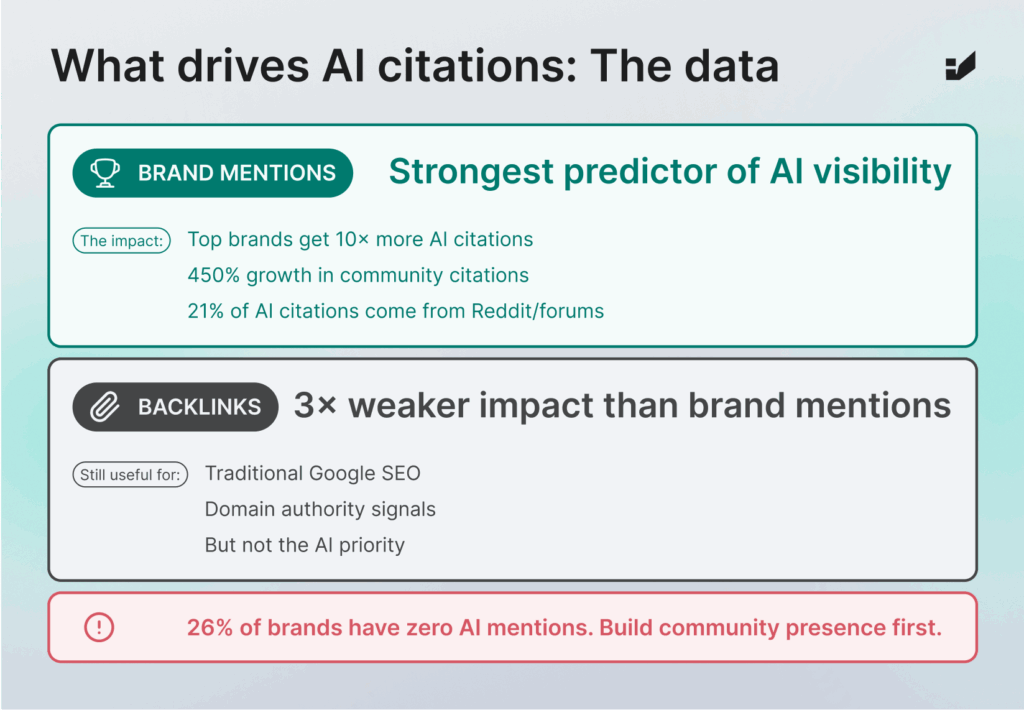
- In Ahrefs’ study of 75,000 brands, branded web mentions showed the strongest correlation with AI Overview visibility (0.664), ahead of branded anchors (0.527), branded search volume (0.392) and backlinks (0.218). Correlation doesn’t prove causation, but the gap is large.
- Brands in the top quarter for web mentions averaged 169 AI Overview mentions, more than 10 times the 14 mentions of brands in the next quarter.
- Community platforms matter, but they are volatile. Reddit was the most cited domain across ChatGPT Search, Google AI Mode and Perplexity in a Semrush analysis of 325,000 prompts (January–February 2026). Yet its share of Perplexity citations fell from 25% to 7% between February and April 2026 (Tinuiti).
- Google warns in its AI features guide that seeking inauthentic mentions isn’t as helpful as it might seem.
What to do: earn mentions rather than buy them. Publish original research, give expert quotes to industry media, collect reviews on relevant platforms and take genuine part in communities. Read more about backlinks and mentions in GEO.
Myth 8: “Optimizing for AI means abandoning traditional SEO”
Short answer: the opposite. Most of what wins AI visibility is solid SEO.
- Google’s guide states that, from Google Search’s perspective, optimizing for generative AI search is still SEO.
- In the AirOps study, retrieval rank was the strongest single signal for a ChatGPT citation. Pages that rank get retrieved, and retrieved pages get cited.
- AI Overviews draw most of their citations from top-10 results (Ahrefs).
What to do: keep investing in technical SEO, indexation in both Google and Bing, internal linking and topical authority. Then add an AI-specific layer: answer-first formatting, off-site brand presence and prompt tracking. See whether search rankings still matter for generative engines.
Myth 9: “You can just use AI to write the content”
Short answer: AI can speed up drafting, but content that only repeats what’s already online gives assistants no reason to cite you.
- Google’s guide advises against recycling what others have already said or what a generative AI model could easily produce.
- Freshness counts: in the AirOps study, pages older than two years were cited less often.
What to do: use AI as an assistant, with human expert review and fact-checking. Add first-hand experience, your own data and examples, a real author byline and a review date. Refresh your key pages regularly. Read more about E-E-A-T in AI search and content decay.
Myth 10: “AI search visibility can’t be measured”
Short answer: it can, just not with a single number.
- Mention rate and share of voice: how often your brand appears in answers to a fixed set of prompts across several models, compared with competitors.
- Citations: which of your URLs are cited, and for which prompts.
- AI referral traffic: sessions from chatgpt.com, perplexity.ai, gemini.google.com and copilot.microsoft.com in GA4.
- Indirect signals: trends in branded search and direct traffic.
AI answers vary from run to run, so repeat each prompt several times and look at trends rather than single responses. We cover this in detail in metrics that matter in AI search and measuring data from generative chatbots.
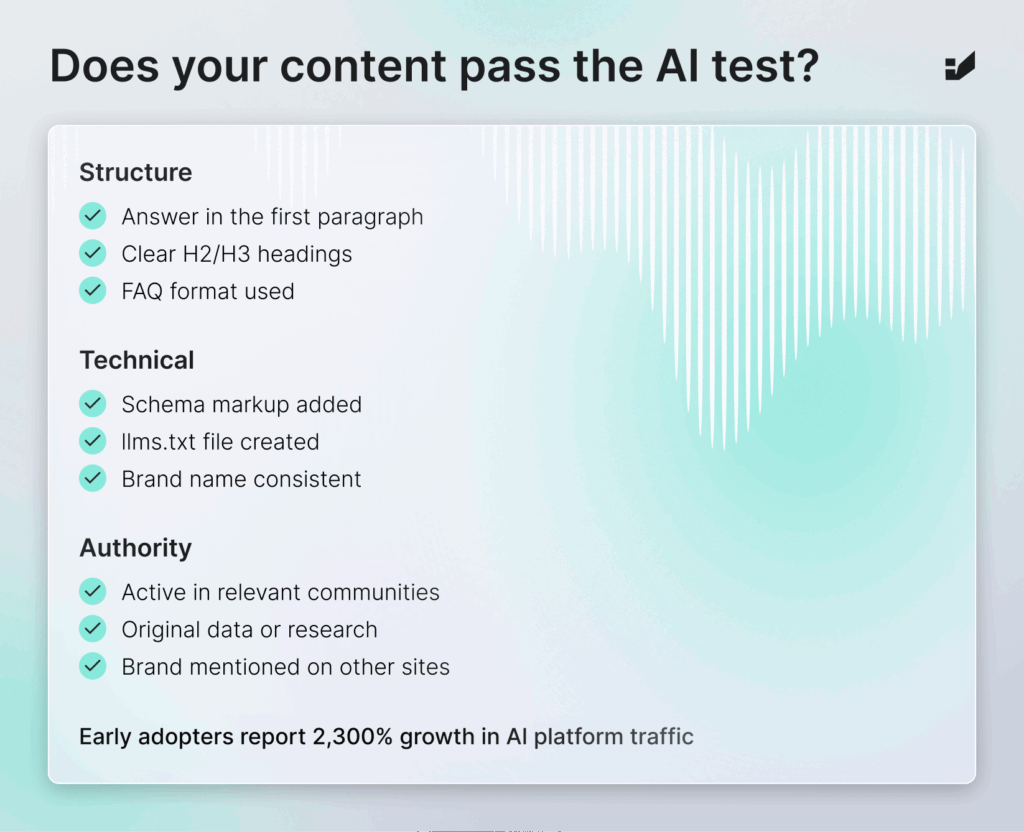
How to build an AI search strategy without the myths
- Run a baseline audit. Check how models describe your brand, which competitors they name and which sources they cite.
- Fix eligibility. Allow AI search crawlers, get indexed in Google and Bing, and serve fast, server-rendered pages.
- Restructure key content. Put the answer first, use question-style headings, keep pages focused and add tables and dated sources.
- Grow your off-site presence. Aim for genuine mentions, reviews, digital PR and community participation.
- Measure and refresh. Track a fixed prompt set every month and refresh priority content every quarter.
AI search is already where many of your customers start their research. Teams that act on evidence rather than myths will be the ones AI systems choose to describe and cite.
Boost sales with SEO + GEO.
FAQ: AI search myths
What is AI search optimization?
AI search optimization, also called generative engine optimization (GEO), means making your brand and content easy for AI systems such as ChatGPT, Gemini, Perplexity and Google AI Overviews to find, understand, mention and cite. It builds on SEO and adds a focus on brand mentions, answer-first content and prompt tracking.
Does ranking on Google help you appear in ChatGPT?
It helps, but it’s not enough. ChatGPT retrieves pages for several rewritten sub-queries, so pages that rank for those sub-questions are cited more often. Only about 12% of URLs cited by AI assistants rank in Google’s top 10 for the original prompt (Ahrefs).
Does llms.txt improve visibility in AI search?
There is no evidence that it does. Google says it doesn’t use llms.txt for AI Overviews or AI Mode, and no major AI provider has confirmed relying on it. The file is optional. Crawl access and content quality matter far more.
Does schema markup help you get cited by AI?
Not directly. A controlled Ahrefs study of 1,885 pages found no meaningful citation lift after adding JSON-LD. Schema is still useful for rich results and for helping search engines understand your entity, so keep it valid and consistent with the visible page content.
What matters most for AI search visibility in 2026?
Three things: being retrievable (crawlable and ranking for the sub-questions people ask), being clearly answerable (focused pages with answer-first sections and matching headings) and being talked about (genuine brand mentions across the web).
How do you measure visibility in AI search?
Track a fixed set of prompts across several AI models and record brand mentions, citations and competitors. Add AI referral sessions in GA4 and trends in branded search. Repeat prompts several times, because individual answers vary.
Sources
- Ahrefs: Only 12% of AI cited URLs rank in Google’s top 10 for the original prompt (August 2025)
- Ahrefs: An analysis of AI Overview brand visibility factors, 75K brands (2025)
- Ahrefs: We tracked 1,885 pages adding schema (May 2026)
- Google Search Central: Optimizing your website for generative AI features on Google Search (May 2026)
- AirOps: The fan-out effect report (2026)
- Pew Research Center: Google users are less likely to click on links when an AI summary appears (July 2025)
- MediaPost on Semrush clickstream study of ChatGPT search (2026)
- TechCrunch: ChatGPT reaches 900M weekly active users (February 2026)
- OpenAI: Overview of OpenAI crawlers
- Search Atlas: The limits of schema markup for AI search (December 2025)
- MediaPost on Tinuiti AI citations report (May 2026)
About the author: Bartosz Wojciechowski wrote this article as part of the Insightland team. Insightland is a Wrocław-based SEO and GEO agency, part of the Hexe Capital Tech Hub. Contact us.