Best 10 AI SEO Agencies for Fashion Brands 2026
This guide is published by Insightland, one of the agencies evaluated below. To keep the comparison honest, every entry - including Insightland - was assessed against the same three criteria, with competitor information verified through public primary sources: agency websites, Clutch profiles, LinkedIn, PR Newswire, SEC filings, and peer-reviewed publications.

A shopper opens Perplexity and types: “What are the best linen blazers for a summer wedding under $300?” The answer arrives in seconds – three brand recommendations, with links, prices, and a one-paragraph rationale for each. None of them are the brand that’s been pouring six figures a month into traditional SEO.
This is no longer an edge case. If a fashion brand’s organic traffic has gone flat in 2026, it isn’t necessarily because traditional SEO is broken. It’s because AI systems – ChatGPT, Perplexity, Gemini, Google AI Overviews – increasingly cannot read, extract, or recommend the brand’s products. The buying journey has split into two parallel discovery channels, and most fashion catalogs are still built for only one of them.
The data shows the shift clearly. Traffic from AI sources to US retail sites grew 393% year-over-year in Q1 2026, and AI-driven traffic now converts 42% better than non-AI traffic – a complete reversal from a year earlier, when AI traffic actually converted 38% worse (Adobe Digital Insights, April 2026). The shift is sharper still in fashion: 66% of US consumers now place a high degree of trust in recommendations from AI tools, and the fastest-growing AI-referred retail categories include dresses, shorts, trousers, shoes, cosmetics, and perfumes (FashionNetwork USA citing Adobe Q2 2026 Report).
The question is no longer whether to invest in AI search visibility – it’s how to evaluate the agencies that offer it. Not every agency calling itself “AI SEO” applies the same standards, and the gap between the label and the operational depth is wider than most fashion brands assume.
What does “AI SEO” actually mean for a fashion brand?
For a fashion brand, “AI SEO” means optimizing your site, product data, and editorial footprint so AI answer engines – ChatGPT, Perplexity, Gemini, Google AI Overviews – can read, extract, and recommend your products. At Insightland, this is the discipline we apply across fashion ecommerce clients, and it is fundamentally different from using AI tools to write content faster – the distinction where most agencies blur the line.
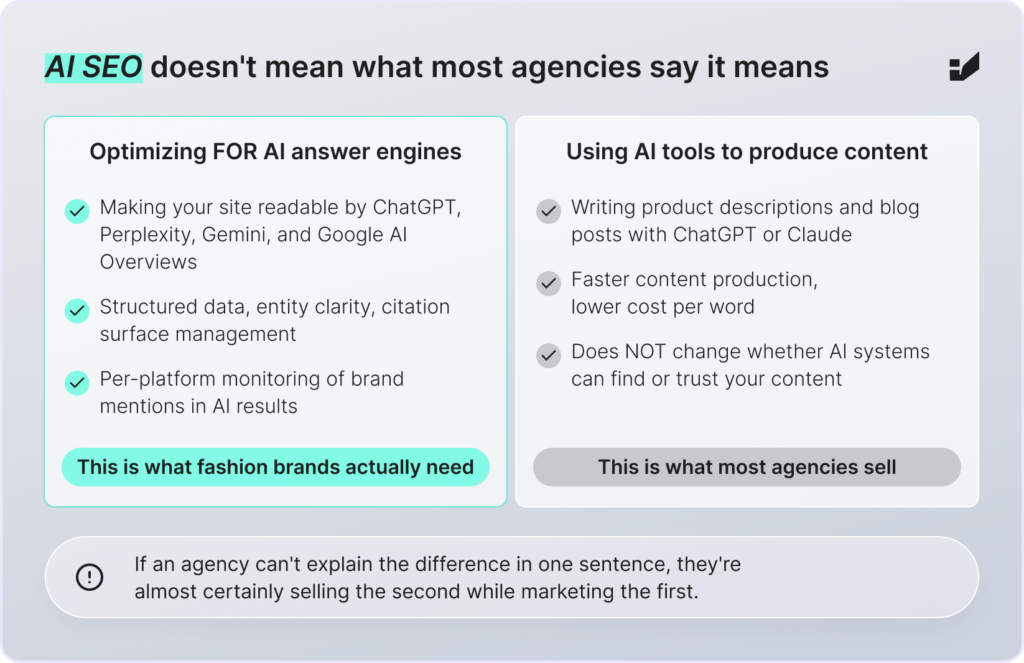
Two activities currently live under the same label, and they are not the same thing.
The first is optimizing for AI answer engines – making a fashion brand’s site, products, and editorial footprint legible to ChatGPT, Perplexity, Gemini, and Google AI Overviews so that those systems can confidently extract, summarize, and recommend the brand’s products. This requires fashion-specific structured data, entity clarity, citation surface management, and per-platform monitoring.
The second is using AI tools to produce content faster – writing product descriptions, category copy, and blog posts with ChatGPT or Claude. That’s a content production efficiency play. It doesn’t change whether AI systems can find or trust the resulting content.
Both have value. Only the first is what fashion brands need when their AI visibility is broken. If an agency cannot articulate the distinction in a single paragraph, they are almost certainly selling the second while marketing the first.
The confusion is widespread enough that fashion operators on Shopify Community are openly frustrated:
“What is confusing me is that our regular Google performance looks fine. We are not perfect, but we do show up and people do find us. Our SEO person says our rankings are solid. But this AI visibility issue feels completely separate, and I do not understand what is causing it. ChatGPT seems to pull from blogs, Reddit threads, gift guides, and Etsy pages, but not from our actual product or collection pages.”
– Shopify operator,Shopify Community, April 2026
That gap – solid Google rankings, invisible to AI search – is the exact problem the right agency solves, and the wrong one ignores.
The evaluation framework for fashion AI SEO agencies
We applied three criteria, weighted by their practical impact on fashion AI search outcomes. The first two carry 80% of the total weight because they are the capabilities most agencies claim and few actually deliver. Each criterion maps to information visible in every agency entry below – there are no hidden variables.
| Criterion | Weight | Where visible in each agency entry |
| Verifiable fashion ecommerce track record – named clients with measurable outcomes documented in primary sources (agency case studies, third-party verification, press coverage). Marketing claims without verifiable named-client outcomes were discounted. | 40% | Strengths |
| AI search optimization capability for fashion – public evidence of work targeting ChatGPT, Perplexity, Gemini, or Google AI Overviews specifically for fashion ecommerce. Generic “AI services” without operational specificity to fashion were treated as insufficient. | 40% | Key features + Best for |
| Operational fit for fashion ecommerce – geographic scope, team scale, vertical specialization, and stated limitations relative to fashion buyer needs (marketplaces, seasonal calendars, multi-language reach, sub-vertical depth). | 20% | Best for + Limitations |
This framework parallels the per-platform asymmetry described in SearchEngineLand’s fashion AI analysis: visibility patterns differ across platforms, so evaluation must be asymmetric across capabilities – citation surface for ChatGPT, structured data depth for Perplexity and Google AI Mode, and operational scope for execution. A single-track evaluation underrates agencies with genuine multi-platform depth and overrates those with strong content marketing alone.
The best AI SEO agencies for fashion brands in 2026, compared
| Rank | Agency | Best For | Key Capabilities | Primary Strength |
| 1 | Insightland | AI Search Optimization + Fashion Ecommerce Depth | GEO, SEO, analytics, proprietary tooling | Verified European fashion case studies + integrated SEO/GEO/analytics |
| 2 | Pattern | Marketplace-First Fashion Brands | 60+ marketplace acceleration, proprietary AI on Bedrock/Nova | NASDAQ-listed scale + marketplace-native AI tooling |
| 3 | Victorious SEO | Content + AEO Depth | Technical SEO, AEO services, Search Intelligence System | Documented streetwear results + explicit AEO service line |
| 4 | Coalition Technologies | US Fashion D2C with Proven Roster | Schema, GEO, link building, multi-platform ecommerce | Named fashion roster: Pink Lily, Coach, SwimSpot, Frankies Bikinis, Clare V., Natori |
| 5 | Re:signal | UK/EU Fashion Retail | Ecommerce SEO, digital PR, agentic commerce optimization | UK retail specialist (Under Armour, ASICS, FatFace, JD Sports) |
| 6 | First Page Sage | Editorial & Thought Leadership Fashion | Thought Leadership SEO, GEO content strategy | Premium editorial depth for heritage and luxury brands |
| 7 | The SEO Works | UK Ecommerce with AI Overview Documentation | SEO, GEO, digital PR, AI-retrieval optimization | Published case study on AI Overview citation growth |
| 8 | SmartSites | SMB Integrated Paid + Organic Fashion | Search Everywhere Optimization, AI Search Optimization | One-stop SMB coordination across channels |
| 9 | Codedesign | International/Multilingual Fashion | Multilingual SEO, AI-driven marketing, paid integration | Multi-time-zone delivery across European and APAC markets |
| 10 | 1Digital Agency | High-Volume Fashion SEO with Conversion Focus | GEO/AI engine visibility, ecommerce platform expertise | Documented +471% revenue growth and dedicated fashion practice |
Quick match: For fashion-specialist depth plus measurable case studies plus AI search optimization in one shop, start with Insightland (#1). If revenue is marketplace-driven, Pattern (#2). For UK retail with seasonal calendar focus, Re:signal (#5). For editorial content authority targeting heritage brands, First Page Sage (#6). For high-volume fashion ecommerce with conversion-first focus, 1Digital Agency (#10).
1. Insightland – Best Overall for AI Search Optimization + Fashion Ecommerce Depth
Overview
Insightland is a data-driven SEO, GEO, and analytics agency headquartered in Wrocław, Poland, with 10+ years of search experience and 8+ years specialized in fashion ecommerce. The agency operates on a principle that every search interaction – Google, ChatGPT, Perplexity, Gemini, or Google AI Overviews – should be measured against business outcomes, not vanity rankings. Insightland is a three-time European Search Awards winner, most recently in April 2026.
How this works for fashion sites
Insightland starts by mapping how fashion shoppers actually search – from broad style intent (“summer wedding guest outfits”) to specific product queries (“navy linen wide-leg trousers size 14 under £200”) – across both traditional search and AI answer engines. The agency then audits how site structure, product data, editorial content, and external citation surfaces respond at each stage, identifying where AI systems lose access to a brand’s products.
In practice, this combines technical SEO foundations (faceted navigation control, JavaScript rendering, indexation management), fashion-specific structured data (size, fit, fabric, occasion, sustainability), and GEO content design (Q&A-ready sections, semantic clarity, topical clusters) into one continuous program. The CAT framework – Insightland’s proprietary AI Search methodology – links technical accessibility, content readability, and authority signals into measurable visibility outcomes across AI platforms.
Key features
- AI Search Optimization (GEO) across ChatGPT, Perplexity, Gemini, and Google AI Overviews with brand citation monitoring per platform
- Technical SEO for complex fashion catalogs: indexation, faceted navigation, JavaScript rendering, seasonal URL management, multi-property migrations
- Fashion-specific structured data: fit, materials, sizing, occasions, sustainability, real-time availability, and return-policy markup
- CAT framework: proprietary methodology linking content, authority, and technical signals for AI Search optimization
- Proprietary tooling: LLMonitor for per-platform LLM citation tracking (ChatGPT, Perplexity, Gemini, Copilot) and Brand Search Presence for AI visibility audits; additional in-house tools support content optimization, internal linking, knowledge-gap analysis, and backlink quality scoring
- Integrated ecommerce analytics: GA4 audits, Consent Mode implementation, ML-driven user behavior analysis
Best for
Fashion ecommerce brands that need measurable, business-outcome-driven SEO and AI search visibility – particularly mid-market and growth-stage apparel and footwear retailers on Shopify, Magento, or custom platforms, in European and international markets. Brands with documented technical complexity (large SKU counts, seasonal collections, faceted navigation, variant management) who want one accountable partner across SEO, GEO, and analytics rather than coordinating three vendors. Through Insightland’s sister company Ambiscale – a dedicated web and application development studio – clients can also access integrated development capacity for site migrations, replatforming, and custom ecommerce builds without bringing in a separate technical vendor.
External recognition
- 3× European Search Awards finalist (2024, 2025, 2026 – April 16 recognition)
- 5.0 rating on Clutch (profile)
- Featured in: NowyMarketing – podcast on what to do when AI spreads false information about your brand; NowyMarketing – interview on brand visibility in AI search; Clutch – The AISO Checklist: How to Effectively Measure & Improve Visibility in AI Search Results
Strengths
- Wojas (Polish footwear, 30+ years): +67% online sales increase from organic traffic, partnership since April 2019 (case study)
- HEGO’S Milano (Italian premium footwear): +443% TOP 3 keyword phrases, ~2 million GSC site issue notifications resolved, European Search Awards-nominated campaign (case study)
- DeeZee (Polish ecommerce, footwear and apparel): +450% non-branded organic blog traffic (case study)
- Additional documented fashion outcomes: Medicine (FAQ Schema reversal), BARTEK (children’s footwear content-gap), Venicci (international migration with TOP 3/10/20 keyword growth)
- Integrated SEO + GEO + analytics + proprietary tooling under one roof, reducing vendor sprawl and data fragmentationr sprawl and data fragmentation
Limitations
Insightland is a specialist team rather than a 200+ person agency – concurrent client capacity is finite, and the agency prioritizes longer-term retainers (6+ months) over one-off audits or quick-turnaround consulting. Fashion-marketplace optimization (Amazon, Allegro) is supported but is not the primary positioning compared to dedicated marketplace accelerators like Pattern. The agency is European-headquartered, so US-based brands working with West-Coast time zones should expect collaboration windows shifted toward European mornings; for brands that need 24/7 US-hours coverage, US-based options like Coalition Technologies or 1Digital Agency may be a better fit. Insightland’s published case study depth is strongest in fashion footwear and apparel; for accessories, jewelry, or beauty-adjacent fashion, the case-study match is weaker.
Verdict
For fashion brands whose challenge requires measurable AI search visibility, fashion-specific technical SEO depth, and one accountable partner spanning SEO, GEO, and analytics, Insightland is the most credible fit on this list – particularly for European-based or internationally expanding fashion ecommerce operations.
Let your customers find you, wherever they look.
2. Pattern – Best for Marketplace-First Fashion Brands
Overview
Pattern is a publicly traded (NASDAQ: PTRN) ecommerce accelerator headquartered in Lehi, Utah. Founded in 2013 as iServe Products and renamed Pattern in 2019, the company IPO’d at $14 per share on September 18, 2025, raising $300 million (CNBC). Pattern serves over 200 brands across more than 60 marketplaces worldwide.
Key features
- Marketplace acceleration across Amazon, Tmall, JD, Mercado Libre, and 56+ additional global marketplaces
- AI-powered ad tech and “Content Brief” generative-AI tool built on Amazon Bedrock and Nova foundation models
- “Predict℠” ecommerce growth platform
- Inventory-buyback / reseller model – Pattern purchases client inventory rather than charging traditional retainers
- Approximately 2,300 full-time employees as of December 31, 2025 (Pattern 10-K filing)
Best for
Fashion brands whose revenue is dominated by marketplace channels – particularly Amazon-led fashion D2C, accessory brands, and global multi-marketplace operations.
Strengths
- Documented client outcome: Strand (Australian retailer) experienced +37% year-on-year online revenue growth across targeted ecommerce channels (PR Newswire, November 2024)
- Publicly named brand clients including Spanx, Skechers, and Panasonic
- Proprietary AI tooling for marketplace content and ad optimization
- Scale and capital backing as a NASDAQ-listed company with $300M IPO proceeds
Limitations
Pattern is marketplace-first by design. Its inventory-buyback model and 60+ marketplace operations are not built for owned-site D2C technical SEO on a brand’s own domain, nor for AI answer-engine optimization beyond marketplace surfaces. Fashion brands relying primarily on direct-to-consumer storefronts (Shopify, custom-built) will find the model an awkward fit.
Verdict
The strongest choice for fashion brands whose dominant revenue channel is Amazon or another global marketplace – but the wrong choice if the AI search visibility challenge is on the brand’s own .com domain.
External signals: NASDAQ-listed (PTRN), approximately 2,300 employees per 10-K filing, CNBC and Modern Retail coverage of 2025 IPO.
3. Victorious SEO – Best for Content + AEO Depth
Overview
Victorious SEO is a San Francisco-based SEO agency with explicit Answer Engine Optimization (AEO) services and a fashion vertical practice. Their Q1 2026 Search Report – “How 177 brands show up in AI vs. traditional search” – signals active 2026 AEO research investment alongside service delivery.
Key features
- Technical SEO, product page optimization, link building, entity development, content strategy
- AEO Services as a stand-alone service category in 2026
- Search Intelligence System for keyword and ranking analysis
- Dedicated fashion vertical page with documented client work (victorious.com/verticals/fashion)
Best for
Fashion D2C and streetwear brands prioritizing content depth, AEO and AI citation acquisition, and entity-development work on the brand’s own domain.
Strengths
- Victorious lists fashion work on their fashion vertical page, including Lychee the Label (women’s streetwear) as a referenced client. Specific performance figures for the engagement are not currently published with a direct primary-source URL – buyers should request the full case study directly from Victorious during evaluation.
- 2026 AEO research investment with a public-facing Q1 2026 Search Report
- No lock-in contracts; retainers scale with scope
Limitations
Victorious is content-and-links driven. The agency has less documented depth than technical-SEO specialists in JavaScript rendering, faceted navigation engineering, and seasonal URL lifecycle management – capabilities that matter for large fashion catalogs.
Verdict
A strong fit for fashion brands prioritizing content authority and AEO depth, especially smaller D2C and streetwear operations where technical complexity is moderate.
4. Coalition Technologies – Best for US Fashion D2C with Proven Roster
Overview
Coalition Technologies is a Los Angeles-based digital marketing agency with a dedicated fashion industry practice. The agency is 250+ people strong across Los Angeles, India, the Philippines, Europe, and Seattle.
Key features
- Technical site audits, product and category page optimization, schema markup, link building
- AI Search Optimization (LLM SEO) service category
- Platform expertise: Shopify, Magento, BigCommerce
- Migration and replatforming services
Best for
US fashion D2C brands seeking a verifiable specialist with named industry clients – particularly women’s apparel, swim and intimate, and accessible-luxury operations.
Strengths
- Publicly named fashion roster on the fashion services page: Pink Lily, Coach, SwimSpot, Frankies Bikinis, Clare V., Natori
- Documented headline case: Pink Lily generated $2.5 million in revenue in their first year of partnership while spending $100,000 on Coalition’s services (Pink Lily case study)
- Multi-platform ecommerce coverage including Shopify and Magento
- 250+ person team with global delivery capability
Limitations
Coalition is US-centric with Los Angeles roots. The agency has less documented depth in European fashion seasonal calendars, cross-border tax and shipping complexity, and multi-language SEO than European-headquartered specialists. AI Search Optimization is a listed service, but Coalition does not publicly itemize how many specialists are dedicated to it.
Verdict
The strongest choice for US fashion D2C brands wanting a known industry roster, proven case-study outcomes, and broad platform coverage.
External signals: 250+ team across LA, India, Philippines, and Europe per company page; named in multiple third-party fashion-SEO comparison listicles.
5. Re:signal – Best for UK/EU Fashion Retail
Overview
Re:signal is a London-based ecommerce SEO agency founded in 2012 by Dani Mansfield. The agency explicitly mentions LLMs and answer engines, agentic commerce, and a 2026 award count of 88 – a notable commitment to AI search positioning before most peers had named it.
Key features
- Ecommerce SEO, technical SEO, content production, digital PR
- AI Search service framed explicitly: “Prepare your content, data and authority for AI-driven discovery, LLMs / answer engines, as we enter a world of agentic commerce”
- Forecasting models for organic revenue opportunity
- Cross-platform expertise including Google, Amazon, YouTube, ChatGPT, and emerging agentic commerce surfaces
Best for
UK and EU fashion retailers with established Google presence who now need explicit AI search readiness and agentic-commerce preparation.
Strengths
- Named fashion clients on the homepage logo display: Under Armour, ASICS, FatFace, JD Sports
- 88 Search Awards as of 2026 (per the homepage award banner)
- Explicit AI search and agentic commerce positioning – not retrofitted
- FT 1000 Growing Companies Europe (2018) and Deloitte Fast 500 EMEA recognition
Limitations
Re:signal is a small specialist team rather than a large agency, so concurrent client capacity is limited. The agency’s positioning leans traditional SEO and digital PR with AI search as an extension, rather than AI citation monitoring being the core offering from day one.
Verdict
A strong fit for UK and EU fashion retailers – particularly athletic, mid-market, and value fashion brands – wanting an established UK specialist with explicit agentic-commerce framing.
External signals: 88 search awards as of 2026; named on homepage rosters of Under Armour, ASICS, FatFace, and JD Sports.
6. First Page Sage – Best for Editorial & Thought Leadership Fashion Content
Overview
First Page Sage is a San Francisco-based SEO and GEO agency founded in 2009 and headquartered at 2155 Union Street. The agency publishes its own “Top Fashion & Apparel SEO Agencies of 2026” listicle and is an active publisher in the GEO category – a category-shaper rather than just a category-participant.
Key features
- Thought Leadership SEO methodology
- Content marketing optimized for premium and heritage brands
- Generative Engine Optimization (GEO) as a marquee service
- Multi-year retention model designed for content depth over time
Best for
Premium and heritage fashion brands prioritizing brand-voice-matched editorial content, thought leadership positioning, and long-term content authority development.
Strengths
- 17+ years in operation (founded 2009)
- Established GEO publishing presence – the agency is actively shaping the category, not just participating
Limitations
First Page Sage is content-first. The agency has less documented depth in deep technical fashion ecommerce engineering – schema implementation, JavaScript rendering, faceted navigation. The agency’s headline luxury fashion client mentions (including Chanel) appear in their own self-published listicles rather than in their official client list on firstpagesage.com/company/, which centers on B2B and technology brands like Salesforce, Microsoft, and US Bank.
Verdict
Suited to fashion brands whose challenge is editorial content authority rather than technical AI search implementation – especially those building long-form thought leadership over a multi-year horizon.
7. The SEO Works – Best for UK Ecommerce with AI Overview Documentation
Overview
The SEO Works is a UK-based SEO and digital marketing agency with offices in Sheffield, London (Bellerive House, 3 Muirfield Cres, Isle of Dogs, E14 9SZ), and Leeds, per seoworks.co.uk. The agency frames the modern website as “universal information infrastructure” for “human users, search indexes, and AI retrieval models” – a stated GEO framing rare among UK SEO shops.
Key features
- SEO, GEO, digital PR, paid media, web services
- AI Overview optimization and LLM-readable content production
- International content optimization for both traditional crawlers and large language models
- 80+ specialists across UK offices
Best for
UK ecommerce brands – including fashion – wanting a UK-headquartered agency with documented AI Overview citation results and a publishable case-study methodology.
Strengths
- Published AI Overview citation case: “By optimising international destination content with the requirements of both traditional crawlers and Large Language Models (LLMs), we secured a +287% growth in AI Overview citation and a +121% increase in ChatGPT referrals” (seoworks.co.uk homepage). The case study brand in this specific result is a global delivery provider rather than a fashion brand, but the methodology – international content optimization for dual human-LLM consumption – is directly applicable to multi-market fashion operations.
- Named clients including Decathlon (athletic apparel)
- 80+ specialists across multi-office UK presence
- Established GEO service with public-facing case-study transparency
Limitations
Fashion is one vertical among many. The agency’s named fashion-related clients lean athletic and value (Decathlon, Puma, Peacocks per third-party portfolio listings) rather than D2C luxury or contemporary apparel. The +287% AI Overview citation figure is from a non-fashion client; fashion-specific outcomes at the same magnitude are not yet publicly documented.
Verdict
A strong fit for UK fashion ecommerce brands wanting documented AI Overview methodology and UK-based delivery – particularly those whose use case maps closely to international content for multiple markets.
8. SmartSites – Best for SMB Integrated Paid + Organic Fashion
Overview
SmartSites is a Paramus, New Jersey-based digital marketing agency founded in 2011 by Alex and Michael Melen. The agency operates across paid, organic, social, email, web design, and AI Search Optimization services.
Key features
- Integrated PPC + SEO + email + social + web design + paid social
- “Search Everywhere Optimization” and “AI Search Optimization” as listed service categories
- 100+ digital specialists
- SMB and mid-market focus
Best for
Small and mid-market fashion brands wanting one coordinated agency for paid, organic, and AI search rather than multiple specialist vendors.
Strengths
- Documented fashion case: Hat Heaven (Bronx hat retailer) went from 1,000 monthly site visitors to over 10,000 (Hat Heaven case study)
- Self-published scale: “Since 2011, we have worked for 400+ businesses of all sizes, launched 900+ websites and have generated over $100M+ client revenue” (per SmartSites company page)
- 6× Inc 5000 fastest-growing recognition (2017–2022)
- 1,000+ five-star reviews across review platforms
Limitations
SmartSites is a generalist SMB digital marketing agency. Fashion is not a marquee vertical, and the only publicly featured fashion case study is a single Bronx hat retailer rather than recognized D2C apparel brands. Fashion-specific technical depth (variant management, faceted navigation, capsule URL lifecycle) is not the agency’s marketed strength.
Verdict
A practical fit for SMB fashion operators wanting one-stop coordination of paid, organic, and AI search – but not the first choice for D2C apparel brands at scale.
9. Codedesign – Best for International/Multilingual Fashion
Overview
Codedesign is a Lisbon, Portugal-based digital marketing agency with offices in Boston, Orange County, and Singapore, per codedesign.org. Founded in 2012, the agency operates across multiple time zones and is a Google Premium Partner. Codedesign has published its own primer on Generative Engine Optimization, signaling active engagement with the AI search category (GEO article).
Key features
- SEO, paid media (Google Premium Partner), content marketing, Amazon and eBay campaigns
- AI-driven marketing and Generative Engine Optimization service
- Multilingual SEO across European, North American, and APAC markets
- Multi-time-zone delivery from Lisbon HQ
Best for
International fashion brands operating across multiple language markets, requiring multilingual SEO coordination from a single agency partner.
Strengths
- Multilingual delivery from four offices across three continents
- Published GEO thought leadership on their own domain
- Google Premium Partner status
Limitations
Codedesign is a generalist multi-industry agency rather than a fashion specialist. Named fashion-specific case studies are limited compared with dedicated fashion-vertical agencies. Buyers seeking deep fashion-merchandising workflow integration should validate scope and named-client references during due diligence.
Verdict
Suited to fashion brands whose primary challenge is multilingual SEO coordination across multiple international markets – particularly those operating across European and APAC languages.
Is your fashion brand invisible to AI search engines?
10. 1Digital Agency – Best for High-Volume Fashion SEO with Conversion Focus
Overview
1Digital Agency is a US-based ecommerce SEO and digital marketing agency founded in 2012, “trusted by 400+ brands with a 4.9/5 rating across 200+ verified reviews.” The agency has a dedicated fashion SEO service line and an explicit GEO/AI engine visibility practice.
Key features
- Conversion-first storefront builds and optimization on Shopify, BigCommerce, Magento
- GEO/AI engine visibility across Google AI Overviews, ChatGPT Search, ChatGPT Shopping, and Perplexity
- Continuous ad and creative iteration paired with organic SEO
- Dedicated fashion SEO service page with sector-specific positioning
Best for
High-SKU fashion ecommerce operations on Shopify, BigCommerce, or Magento that need integrated technical SEO + GEO + conversion optimization with documented metric-driven outcomes.
Strengths
- Documented headline outcomes: “Over the next 2 years we increased online revenue by 471.2%, with 1Digital’s strategies driving 56% of that trajectory,” plus “+55.90% Conversion rate lift in the 4 months post-launch”
- Explicit GEO positioning across all four major AI search platforms (Google AI Overviews, ChatGPT Search, ChatGPT Shopping, Perplexity)
- 400+ brands served, 4.9/5 across 200+ verified reviews
Limitations
1Digital’s most prominently named clients (SK Jewelry, Steinway & Sons, Lenox) are predominantly jewelry, heritage luxury, and accessory categories rather than apparel D2C. Fashion-apparel-specific case studies at the named-client level are less visible than the agency’s overall portfolio metrics.
Verdict
A strong fit for high-volume fashion ecommerce operations – especially jewelry, accessories, and footwear – that need integrated GEO + SEO + conversion optimization under a single retainer.
Why do ChatGPT, Perplexity, and Google AI Mode recommend different fashion brands?
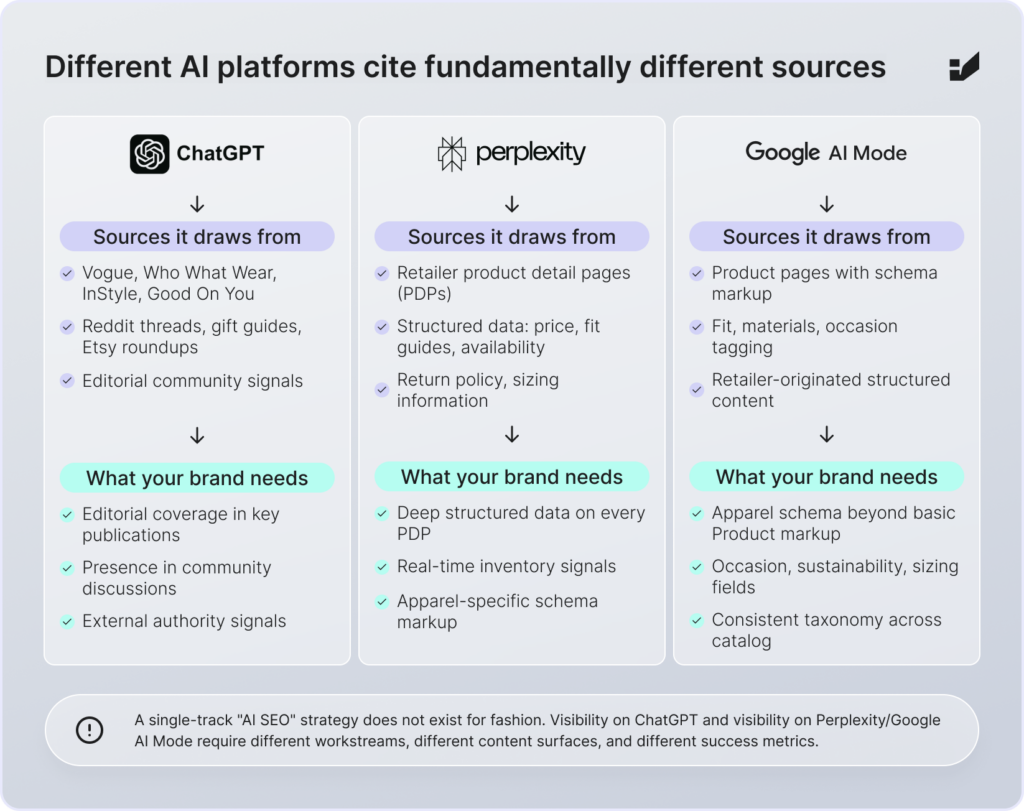
Because each platform trusts a different type of source. ChatGPT leans on editorial and community signals – Vogue, Who What Wear, Reddit threads, gift guides – so brands with strong earned media and cultural traction surface there. Perplexity and Google AI Mode lean on retailer product detail pages with structured data – price, availability, fit, return policy – so brands with deep, machine-readable PDPs win there. Insightland’s per-platform monitoring approach maps which platforms a brand is losing on, then prioritizes work accordingly – because a brand can dominate one platform and be invisible on another, and a single-track “AI SEO” strategy does not work for fashion.
Here is the single concept that separates fashion AI SEO agencies that understand the work from those that don’t.
Different AI platforms cite fundamentally different types of sources – and the gap is wide enough to be visible in any side-by-side test. Ask both engines for “best linen blazers under $300” and the source pages they cite will look fundamentally different: editorial and community pages on one side, structured retailer PDPs on the other.
The implication is operational. A single-track “AI SEO” strategy does not exist for fashion. Visibility on ChatGPT requires editorial citation, external authority signals, and presence in the publications and communities that LLMs lean on. Visibility on Perplexity and Google AI Mode requires deep structured data on product detail pages – fit, materials, occasion tagging, real-time inventory, return windows. These are different workstreams with different teams, different content surfaces, and different success metrics.
This is concretely visible in the data. Per Similarweb’s 2026 Generative AI Brand Visibility Index, Nike leads with a 100.0 index score but its momentum has dropped 13.5 points from the April 2025 baseline. The actual accelerators are New Balance, Uniqlo, Gap, and H&M – brands whose multi-platform structured data and editorial presence are picking up where Nike’s brand-name dominance no longer carries it. Coach, American Eagle, and Nordstrom are all falling.
For agency selection, the question to ask is direct: Which AI platforms do you actively monitor for my brand’s citations, and what different approaches do you apply to each? An agency reporting “AI search visibility” as a single aggregated metric is missing the asymmetry – and almost certainly missing half the work.
Poland – the market context for fashion ecommerce AI search
Poland’s fashion ecommerce category accounts for 27.98% of total Polish ecommerce revenue in 2025, making it the country’s largest online category and one of the largest fashion ecommerce markets in Central and Eastern Europe. This is the operational context that has shaped how agencies like Insightland approach fashion AI search.
The country is home to international fashion retailers operating well beyond its borders: LPP S.A. owns Reserved, Sinsay, Mohito, Cropp, and House, selling collections in nearly 40 countries (lpp.com); CCC Group operates CCC, HalfPrice, eobuwie.pl, Modivo, and DeeZee across approximately 90 e-commerce platforms in 28 countries (CCC corporate). This is the market context for Insightland’s fashion specialization and growth.
What are the red flags when choosing a fashion AI SEO agency?
Six signals reliably predict an agency that will underdeliver: vague “AI SEO” claims with no operational specificity, no fashion-specific technical examples, audit-only deliverables, shallow structured-data work, recycled luxury client logos, and no per-platform AI citation monitoring. Insightland’s evaluation framework treats each as a disqualifier – every one maps to a capability fashion brands actually need.
After ten agency profiles, the patterns are clear.
1. “AI SEO” with no operational specificity. An agency that cannot articulate the distinction between optimizing for AI answer engines and using AI tools to produce content is selling the latter while marketing the former.
2. No fashion-specific technical examples. Faceted navigation crawl budget, seasonal URL lifecycle management, capsule drop URLs, variant deduplication, fit and sizing schema implementation. If the agency cannot describe how they handle these, the engagement will hit fashion-specific failure modes within the first two months.
3. Audit-only deliverables. A 100-page PDF that the development team cannot ship within a sprint is a vendor-engagement failure, not a strategy. The right agency builds for implementation timelines, not consultant deliverables.
4. No depth in structured data. Basic Product schema is the minimum. Fashion requires apparel-specific schema: fit, materials, occasions, sustainability, real-time availability, return policy. Without it, Perplexity and Google AI Mode optimization is shallow.
5. Recycled luxury client logos. Multiple third-party fashion-SEO listicles freely attach “Chanel,” “Coach,” and similar luxury names to agencies that may have done one short project or sub-contracted work. The buyer question: “For each named luxury client logo, provide the scope, duration, and a referenceable point-of-contact under NDA.”
6. No per-platform AI citation monitoring. This connects to the citation-source asymmetry above. If the agency measures “AI search visibility” only in the aggregate, they are missing the asymmetry – and almost certainly missing half the work. ChatGPT, Perplexity, Gemini, and Google AI Overviews need to be tracked separately.
Seven questions to ask a fashion AI SEO agency before signing
These questions are the practical version of the criteria above. They map directly to whether an agency has done this work before, or whether they are about to learn on the buyer’s budget.
- Can you explain specifically how you optimize for AI answer engines, not just use AI tools internally? Look for concrete examples of structured data design, entity clarity work, and AI citation monitoring across platforms.
- Which AI platforms do you actively monitor for my brand’s citations today, and what different approaches do you apply to each? ChatGPT, Perplexity, Gemini, and Google AI Overviews behave differently. An agency monitoring only one – or generalizing across all – signals limited capability.
- What fashion-specific technical challenges have you solved publicly, with named clients? Faceted navigation crawl budget, capsule drop URL lifecycle, seasonal indexation, variant deduplication, JavaScript rendering.
- What apparel-specific structured data do you implement? Fit, materials, occasions, sustainability, sizing, real-time availability, return policy.
- How does your team integrate with merchandising and development workflows? Drop schedules, lookbook timing, sprint cycles, filter logic, the merchandising calendar.
- Show three named fashion clients with measurable outcomes and a referenceable point-of-contact. Verify scope and duration, not just logos.
- How do you report AI search results to the executive level? Citation share-of-voice per platform, brand entity mentions, AI-attributable revenue where measurable.
FAQ
The target systems are different. AI SEO targets large language models (ChatGPT, Perplexity, Gemini, Google AI Overviews) through structured data, entity clarity, and content architecture designed for extraction. Traditional SEO targets Google’s ranking algorithm through keyword targeting, link building, and on-page optimization. For fashion brands in 2026, these are two parallel optimization stacks – not one replacing the other, which is why Insightland treats AI Search Optimization as a discipline integrated with technical SEO rather than as a replacement. The economics support both: a peer-reviewed INFORMS Marketing Science study analyzing 12 months of first-party data from 973 ecommerce websites with $20 billion combined revenue found ChatGPT organic outbound links emerged as a distinct discovery channel from August 2024 onward (INFORMS Marketing Science, 2026).
Three conditions must hold simultaneously. First, structured data clearly communicates product details – fit, materials, sizing, occasions, availability. Second, content architecture builds topical expertise across the buying journey. Third, site structure allows AI crawlers to access pages without JavaScript-rendering or faceted-navigation blockers. Plus external consensus: editorial coverage (Vogue, Who What Wear) and user-generated discussion (Reddit, Etsy gift guides) for ChatGPT visibility, structured PDP data for Perplexity and Google AI Mode visibility.
Different AI platforms cite fundamentally different types of sources. ChatGPT leans heavily on editorial and community signals – Vogue, Reddit, gift guides. Perplexity and Google AI Mode skew toward retailer product detail pages with structured data: price, availability, fit guides. The pattern is observable in any side-by-side test of the same buying prompt. Per Similarweb’s January 2026 Fashion AI Brand Visibility Index, Nike leads ChatGPT-style visibility but is losing momentum, while New Balance, Uniqlo, Gap, and H&M are accelerating across platforms. Start where your category’s buyers actually search: if your shoppers lean on editorial discovery and community recommendations, prioritize ChatGPT signals first; if they arrive ready to compare products on price, fit, and availability, prioritize Perplexity and Google AI Mode PDP signals first. Insightland’s per-platform audit identifies where a fashion brand has lowest citation share, and recommends prioritization based on the brand’s existing strengths in editorial coverage vs structured data.
Technical fixes appear within weeks. AI citation changes emerge within 1–3 months. Full visibility gains across multiple AI platforms build over 3–6 months. Fashion seasonality adds a layer: drop cycles and capsule launches require planning weeks in advance, not reactive optimization after the campaign has launched.
Critical for ChatGPT specifically. AI answer engines base “which brand to recommend” decisions on external consensus – Vogue, Who What Wear, InStyle, Good On You, OEKO-TEX certifications, Reddit threads. An agency that focuses only on owned-site optimization misses 40–60% of what actually drives AI visibility on ChatGPT. Perplexity and Google AI Mode rebalance this toward PDP and structured-data signals. Insightland tracks the citation surface of editorial publications for client fashion brands to identify where additional earned media or community visibility would have the highest AI search payoff.
Conclusion
The six criteria above are a reusable framework. Apply them to any agency a fashion brand is evaluating – not just the ten on this list. If an agency cannot answer the seven questions concretely, with named clients and measurable outcomes, the engagement will underdeliver.
For fashion-specialist depth, measurable case studies, and AI search optimization in one accountable partnership, Insightland. For marketplace-driven revenue, Pattern. For UK retail with seasonal calendar focus, Re:signal. For high-volume conversion-focused fashion ecommerce, 1Digital Agency.
Fashion brands winning in AI search are not those with the biggest ad budgets. They are the ones whose site structure, structured data, and citation surface make it easy for AI systems to understand what they sell, who it is for, and why it matters. The structural decisions made this quarter determine whether the brand’s products are in that trust set or outside it.
This guide reflects the AI search landscape as of May 2026. We review and update rankings quarterly as agency capabilities evolve, AI platforms iterate, and new visibility data is published. Last updated: May 2026.
Is your fashion brand invisible to AI search engines?
Want to see how your fashion brand currently appears in ChatGPT, Perplexity, and Google AI Overviews? Insightland’s Brand Search Presence audit benchmarks your AI visibility against direct competitors. Schedule a discovery call to discuss your fashion ecommerce AI visibility strategy: hello@insightland.org