How fast is AI really growing? Key stats that show why now is the time to invest
Just a few years ago, artificial intelligence was treated as a futuristic add-on - something that would soon "change the world." Today, we're talking about the present.

Key takeaways
- ChatGPT reached 900 million weekly active users in February 2026, up from 400 million a year earlier (OpenAI).
- Google says AI Overviews reach more than 2.5 billion monthly users and AI Mode more than 1 billion (May 2026).
- In Poland, ChatGPT had 9.3 million real users in June 2025, roughly a third of the country’s internet users (Gemius).
- AI still sends a small share of website traffic, about 0.3–1% depending on the study, but that share grew 16x between 2024 and 2026 (SE Ranking).
- Google search isn’t shrinking: Alphabet reported its fastest query growth in five years in Q3 2026, partly thanks to AI features.
- 58% of consumers say they have replaced search engines with generative AI tools when looking for product or service recommendations (Capgemini).
A few years ago, generative AI was a novelty. Today, assistants such as ChatGPT, Gemini, Copilot and Perplexity, and AI features inside Google Search, are part of how hundreds of millions of people look for information and decide what to buy. Everyone says the market is growing fast. This article puts numbers on it: who uses AI, how it is changing Google, how much traffic it sends to websites and what that means for businesses. Each statistic includes its source and date, and we update the figures regularly.
AI search statistics at a glance
| Statistic | Value | Source, date |
|---|---|---|
| ChatGPT weekly active users | 900 million | OpenAI via TechCrunch, Feb 2026 |
| Gemini app monthly active users | 900 million+ | Google I/O, May 2026 |
| Google AI Overviews monthly users | 2.5 billion+ | Google I/O, May 2026 |
| Google AI Mode monthly users | 1 billion+ | Google I/O, May 2026 |
| ChatGPT real users in Poland | 9.3 million | Gemius, Jun 2025 |
| Share of US searches showing an AI Overview | 43% | Similarweb, May 2026 |
| Clicks on results when an AI summary appears | 8% vs 15% without | Pew Research, Mar 2025 data |
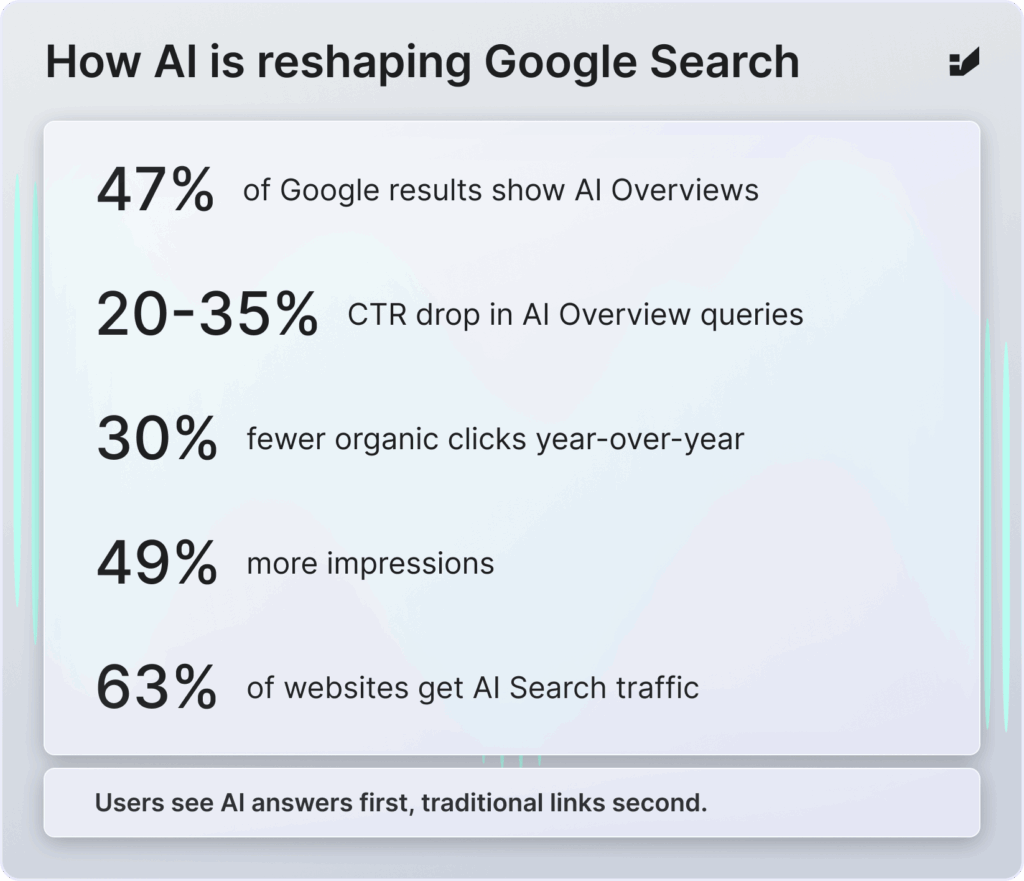
| Websites receiving at least some AI traffic | 63% | Ahrefs, early 2025 |
| AI share of all website traffic | 0.32% | SE Ranking, 2026 |
| Consumers who replaced search engines with gen AI for recommendations | 58% | Capgemini, Jan 2025 |
| AI referral conversion vs other sources (US retail) | +31% | Adobe, holiday 2025 |
| Global AI market size | $900 billion | Precedence Research, 2026 estimate |
How many people use AI assistants?
Short answer: nearly a billion people a week use ChatGPT alone, and Google’s AI features reach even more.
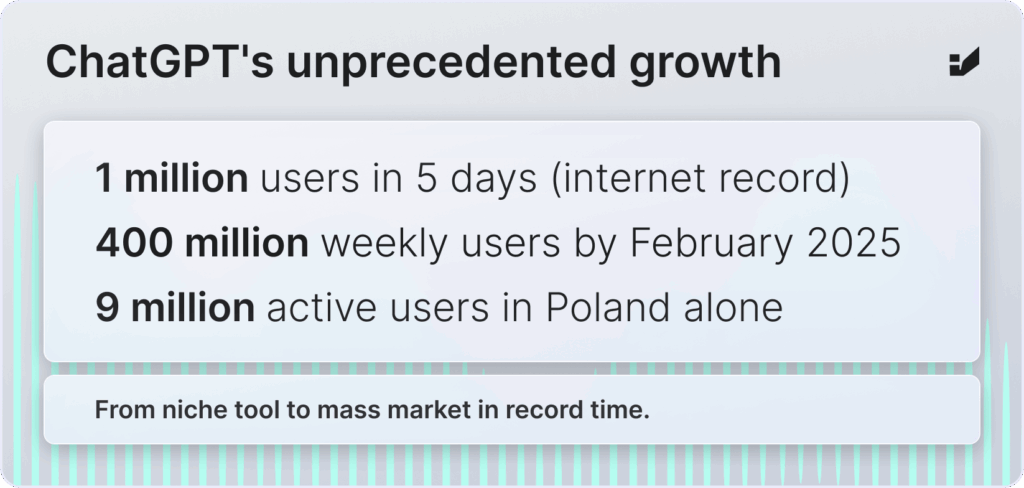
- ChatGPT reached 1 million users within five days of launch in late 2022, the fastest start of any consumer app at the time.
- By February 2026, OpenAI reported 900 million weekly active users, up from 400 million in February 2025.
- At Google I/O in May 2026, Google said the Gemini app had more than 900 million monthly active users, up from 400 million a year earlier.
- Google’s AI features inside Search reach even more people: more than 2.5 billion monthly users for AI Overviews and more than 1 billion for AI Mode.
- In Poland, Gemius measured 9.3 million real ChatGPT users in June 2025, up from 3.6 million in January 2025. That is almost one in three Polish internet users.
How is AI changing Google search?
Short answer: AI answers now appear on a large share of searches and reduce clicks to websites, but people are searching on Google more, not less.
How often do AI Overviews appear?
It depends on how you measure. Studies of keyword-style searches report lower shares, while studies of longer, conversational prompts report much higher ones:
| Study | Share of searches with an AI Overview | Sample |
|---|---|---|
| Similarweb | 43% (up from ~15% a year earlier) | US searches, May 2026 |
| Advanced Web Ranking via Xponent21 | 49% non-personalised, 65% personalised | 8,000 US keywords, Mar 2026 |
| Peec AI | 87% (up from 57% a year earlier) | 500,000 prompts, Apr 2026 |
The trend is the same in every dataset: AI Overviews are showing up on more searches each year, especially longer questions and comparisons.
Do AI Overviews reduce clicks?
- Pew Research Center found that users clicked a regular search result in 8% of visits when an AI summary appeared, compared with 15% when it didn’t. Links inside the summary were clicked in just 1% of visits.
- BrightEdge reported that in the first year of AI Overviews (to May 2025), search impressions rose by more than 49% while click-through rates fell by nearly 30%.
Is Google search volume falling?
Not so far. In February 2024, Gartner predicted that traditional search engine volume would drop 25% by 2026 as people moved to AI chatbots. Google’s own figures point the other way: Alphabet said queries were at an all-time high in Q1 2026 and reported its fastest search query growth in five years in Q3 2026, crediting AI Overviews and AI Mode. People are searching more, but more of their questions are answered on the results page.
Let your customers find you, wherever they look.
How is consumer behaviour changing?
A Capgemini survey of 12,000 consumers in 12 countries (October–November 2024) found that:
- 58% have replaced traditional search engines with generative AI tools as their go-to source for product and service recommendations, up from 25% in 2023.
- Three-quarters are open to generative AI recommendations, up from 63% in 2023.
- 71% want generative AI integrated into their shopping experiences.
Enthusiasm isn’t the same as trust, though. In the same research, satisfaction with generative AI fell from 41% in 2023 to 37% in 2024. Shoppers use AI to research, but they still check what it tells them, which is why consistent, accurate information about your brand across the web matters.
How much traffic does AI send to websites?
Short answer: still a small share of total traffic, but it’s growing fast and often converts well.
- In an Ahrefs study of 3,000 websites (early 2025), 63% received at least some traffic from AI chatbots, but AI accounted for only 0.17% of the average site’s traffic.
- SE Ranking measured AI’s share of all website traffic at 0.32% in 2026, up from 0.02% in 2024, a 16-fold increase. Organic search still accounted for 42.75% of traffic, about 134 times more.
- Measured differently, Conductor’s 2026 benchmarks put AI referrals at 1.08% of traffic across 13,770 domains.
- ChatGPT sends most AI referrals: about three-quarters in SE Ranking’s 2026 data. It also runs a live web search only for part of its answers (34.5% of queries in February 2026, according to Semrush), so many mentions of your brand come with no link at all.
- For retailers, AI visitors can be valuable. Adobe found that during the 2025 holiday season, traffic from generative AI to US retail sites grew 693% year on year and converted 31% better than other traffic sources.
Keep in mind that AI traffic is undercounted. Clicks from AI Overviews are reported as Google traffic, and some app visits arrive without a referrer. See how to measure it in metrics that matter in AI search.
How big is the AI market?
Precedence Research estimates the global AI market at $757.6 billion in 2025 and $900 billion in 2026, and projects it to reach $4.2 trillion by 2035. Other firms give lower figures because they define the market more narrowly, so compare estimates only within the same source. Whatever the exact number, budgets for AI tools, and for visibility inside them, are growing quickly.
What do these numbers mean for your business?
The data supports three conclusions:
- AI is where research starts, even when the click happens elsewhere. Hundreds of millions of people ask assistants for recommendations. If your brand isn’t mentioned, you may not make the shortlist, whatever your Google ranking. See 10 AI search myths.
- Google still matters most for traffic. Organic search sends over a hundred times more visits than AI assistants, and Google’s AI features draw on its search results. Keep investing in SEO. See whether search rankings still matter.
- Early visibility compounds. In Ahrefs’ study of 75,000 brands, brands in the top quarter for web mentions earned more than ten times as many AI Overview mentions as the next quarter. Brands that become the “default answer” early are hard to displace.
Why is now a good time to invest in AI search visibility?
Those who invested early in SEO or social media enjoyed years of advantage that latecomers struggled to catch up with. AI search is at a similar point: audiences are already huge, but many companies haven’t yet measured or optimised how AI describes them. A practical starting point:
- Measure your baseline: how often AI assistants mention your brand and competitors for the questions your customers ask.
- Make your key pages easy to cite: answer-first sections, question headings, dated facts and regular updates (see content decay).
- For e-commerce, complete your product feeds and product pages (see product descriptions for AI search).
- Earn genuine mentions in the media, reviews and communities your customers trust.
Not sure where to begin? Read 5 questions to ask before investing in AI search optimization or our guide to generative engine optimization.
Get found by AI. Grow beyond Google.
FAQ: AI search statistics
How many people use ChatGPT in 2026?
OpenAI reported 900 million weekly active users in February 2026, up from 400 million in February 2025. In Poland, Gemius measured 9.3 million real ChatGPT users in June 2025.
How many people use Google AI Overviews and AI Mode?
Google said at I/O in May 2026 that AI Overviews reach more than 2.5 billion monthly users and AI Mode more than 1 billion, about a year after AI Mode launched.
How often do AI Overviews appear in Google search?
Estimates range from about 43% of US searches (Similarweb, May 2026) to 87% of conversational prompts (Peec AI, April 2026). The share depends on query type: longer questions and comparisons trigger AI Overviews far more often than short keywords.
How much website traffic comes from AI?
Between about 0.3% and 1% of total website traffic, depending on the study: 0.32% in SE Ranking’s 2026 data and 1.08% in Conductor’s 2026 benchmarks. The share grew 16-fold between 2024 and 2026, and ChatGPT sends most of it.
Is AI replacing Google search?
Not yet. Google reported record query volumes in 2026 and its fastest query growth in five years in Q3 2026. What’s changing is how often searches end with an AI answer instead of a click.
Does traffic from AI convert?
It can. Adobe found that AI referrals to US retail sites converted 31% better than other sources during the 2025 holiday season. Results vary by industry, so track AI referrals separately in your analytics.
Sources
- TechCrunch: ChatGPT reaches 900M weekly active users (Feb 2026)
- Neowin: Google I/O 2026 user figures (May 2026)
- Gemius: How do Polish internet users use ChatGPT? (Aug 2025)
- Similarweb data via Pasquale Pillitteri: AI Overviews in 43% of searches (Jul 2026)
- Peec AI: AI Overviews in 87% of 500,000 prompts (2026)
- Pew Research Center: Google users are less likely to click on links when an AI summary appears (Jul 2025)
- BrightEdge: One year into Google AI Overviews (May 2025)
- Gartner: Search engine volume will drop 25% by 2026 (Feb 2024)
- Search Engine Journal: Google Search revenue grew 19% in Q1 (Apr 2026)
- Digit: Pichai on Q3 2026 query growth (Oct 2026)
- Capgemini: 71% of consumers want generative AI integrated into their shopping experiences (Jan 2025)
- Ahrefs: 63% of websites receive AI traffic (2025)
- SE Ranking: AI traffic grew 16x from 2024 to 2026 (Jun 2026)
- Adobe: AI-driven traffic surges across industries (Jan 2026)
- The Silicon Review: Artificial intelligence market statistics (Precedence Research) (Oct 2026)
About the author: This article was prepared by the Insightland SEO and GEO team. Insightland is a Wrocław-based agency, part of the Hexe Capital Tech Hub, that connects business, tech and data: SEO and GEO, performance marketing, UX and analytics, and SEO and AI training. Contact us.